WASHINGTON (RNS) — It’s been 30 years since Jorge Garcia last joined the millions of people who have crowded the streets of Barquisimeto in northwest Venezuela for a procession with La Divina Pastora or “the Divine Shepherdess.”
But three decades and thousands of miles have not dimmed his devotion to the Marian image and statue credited with several miracles, including interceding to end a 19th-century cholera epidemic. This year, after months of work by the four members of the Washington-area Society of La Divina Pastora, she was honored for the first time with a Mass on Wednesday (Jan. 14) in Washington’s Cathedral of St. Matthew the Apostle and with a new statue shipped from Venezuela where it was created by a famous teenage artist.
The statue of La Divina Pastora arrived on Jan. 2, just hours before the U.S. military seized Venezuelan President Nicolás Maduro.
“It’s not us. It’s God who moves everything,” Garcia said.
La Divina Pastora’s celebration came at a moment when Venezuelans in the diaspora and homeland are navigating uncertainty, big emotions and fervent prayers. Many Catholics agree the church will play a significant role in guiding Venezuela’s future — though they are not all in agreement of what’s needed. Many Venezuelan Catholics in the diaspora are hopeful Maduro’s capture and U.S. intervention signals an end to government corruption and an opportunity for economic growth. Catholics in the country are less convinced and more divided on who should lead the country — and where Venezuela’s Catholic leadership should lend its support.
Garcia, who immigrated to the U.S. from Venezuela in 1996, hopes that he can someday soon take his children to Barquisimeto for the procession and return to Venezuela, which he has not returned to because of opposition to the socialist government.
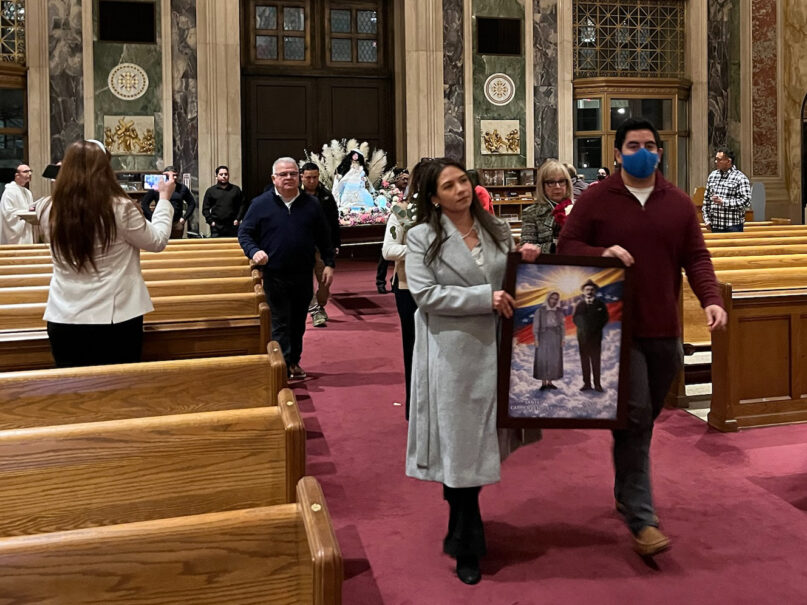
The society for La Divina Pastora worked to keep the celebration free from politics, with no specific political mentions in the Prayers of the Faithful or the homily about listening to God. But politics still bled through in the crowd’s shouts for a free Venezuela after “Long Live the Divina Pastora” and in the posters calling for the freedom of political prisoners, held up while participants took photos next to the statue.
In Barquisimeto, where Venezuelan media said almost 4 million people turned out to walk with La Divina Pastora on Wednesday, Archbishop Polito Rodríguez Méndez also prayed publicly for rights to free expression and for political prisoners, saying, “We pray for all those deprived of liberty. We applaud that some have already been released, but there are many others whose cries and those of their families cannot continue to be ignored.”
He also prayed for migrants, those experiencing hunger and those killed in “the events of Jan. 3.”
Venezuela’s Catholic bishops have often taken a critical stance toward Maduro and President Hugo Chávez, Maduro’s predecessor. Archbishop Ramón Ovidio Pérez Morales, the 93-year-old retired archbishop of Los Teques, has long accused the Maduro government of violating human rights and of corruption.
In a Spanish-language interview with RNS on Wednesday, Pérez Morales commented on the ongoing international discussions about the fate of Venezuela and its sovereignty, debates he said that can distance the conversation from human rights.

“Sovereignty is made for the people, not people for the sovereignty,” he said, echoing Jesus’ teaching that “the Sabbath was made for man, not man for the Sabbath.”
Pérez Morales said he believes there is a path opening “that will lead to the reshaping of the country along democratic and constitutional lines.”
“The constitution isn’t ideal or perfect, but it is a fairly acceptable constitution,” he added.
Venezuelan opposition leader María Corina Machado, a Catholic, met with President Trump on Thursday, presenting him with her Nobel Peace Prize. Her party’s candidate was recognized by international observers as winning the 2024 election, even as Maduro’s government claimed it won. Despite the meeting with Machado, the White House press secretary said she expected “cooperation” to continue between Trump and Maduro’s successor, Delcy Rogriguez, who is now acting president.
While the Venezuelan diaspora has overwhelmingly approved of Maduro’s capture, according to an AtlasIntel poll conducted shortly afterward, less than half of Venezuelans inside Venezuela approved of his capture — about a quarter of Venezuelans disapproved and another 28% said they were unsure how they felt.
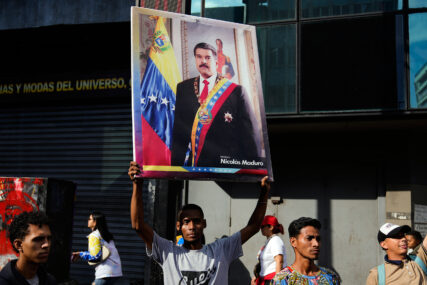
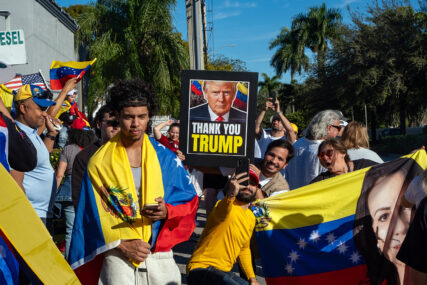
Sister Maria Eugenia Russian, president of Fundalatin, an ecumenical Christian organization founded in Venezuela and inspired by liberation theology, called Trump “the Herod of this time” and said U.S. leaders should denounce his intervention in Venezuela, which killed more than 100 people according to the Venezuelan government, and instead tell him to focus on the poor people of the U.S.
“The Catholic people continue denouncing in the streets the imprisonment of the constitutional president of the Bolivarian Republic of Venezuela by the United States,” said Russian, who is also director of the religious community named for Fundalatin’s founder, the Rev. Juan Vives Suriá.
Russian accused the Venezuelan bishops of having “no closeness with the poor” and said there are two churches in the country — that of the hierarchy and that of the people.
“Over 26 years they have allied themselves with the power of money,” she said of the bishops.
In Spanish WhatsApp messages to RNS on the day of the Divina Pastora celebration, she wrote, “The bishops continue with their lies to use the space of processions to spread lies and defame the reality of a government whose priority is the poor.”
Macky Arenas, a television presenter based in Caracas and the editor of Venezuelan publication “Reporte Católico Laico,” or the “Lay Catholic Report,” believes “the duty of the church is to be brave.”
She cited Cardinal Rosalio Castillo Lara’s 2006 homily for the celebration of the Divina Pastora, where he warned that the democratically elected Chávez government was showing signs of becoming a dictatorship by restricting freedom of expression and abusing human rights. She also called Pérez Morales, the retired archbishop, a “leading voice” for the country.
Arenas said the government’s corruption had led to a humanitarian disaster in Venezuela and that Venezuelan families are facing “intolerable” conditions.
“The people are having less and less access to basic necessities,” she said, and they are facing barriers to access for education and health care.
In a webinar for the Maryknoll Office for Global Concerns, Lisa Sullivan, who served as a Maryknoll lay missioner and lived in Venezuela for more than 30 years until she came back to the U.S. in 2022, instead blamed U.S. sanctions during Trump’s first term for Venezuela’s massive inflation and “hunger years,” saying that sanctioning the oil industry was “like putting a boot on the throat of the Venezuelan people.”
“There was an average weight loss of 20 pounds,” she said. “It was the thinnest I’d ever been. We were all hungry.”
Back in Barquisimeto on Wednesday, Angel González said that, while he was unable to attend the procession, he heard the prayers of many are focused on peace and that the social media videos of the race held in La Divina Pastora’s honor showed large crowds showing up despite the rain.

González, who works to empower children through the Regional Coordination for Boys, Girls and Youth Workers called CORENATS, said in Spanish that, after the “criminal” bombing of Caracas, local children in Barquisimeto are feeling “fear for what could happen in the future if the situation gets worse, fear of losing a family member or losing their own lives.”
Historically, he said, the people have asked La Divina Pastora “for peace in our country, for us to have a country of justice and equity, for healing of illnesses.”
“I think it’s important, as I understand it, that the call that the church is taking up is the call for peace and reconciliation and for the self-determination of the Venezuelan people,” González said.
In southern Venezuela, an indigenous Baniwa Catholic human rights worker told RNS that he still did not feel it was safe for him to speak openly about his opposition to the government and about the “complex emergency humanitarian situation in the country.” He said in Spanish, “there’s a perception that apparently things are changing, going to change, but in terms of reality that hasn’t happened.”
He said that, despite his convictions, he has family members who are committed to the government’s socialist party and that the country faces political fragmentation. In that environment, he said the church must work toward helping Venezuelans understand each other and not see each other as enemies.
“The Catholic church and the evangelical church and all of the organizations of social order in this country have to play an important role in encounter, in forgiveness, in national reconciliation,” the leader said.
Original Source: