(The Conversation) — U.S. President Donald Trump has, for the moment, indicated a willingness to abandon his threat to take over Greenland through military force – saying that he prefers negotiation to invasion. He is, however, continuing to assert that the United States ought to acquire ownership of the self-governing territory.
Trump has repeatedly raised the possibility of using military action, against both Greenland and Canada.
These threats were often taken as fanciful. The fact that he has, successfully, used military force to remove Venezuelan President Nicolas Maduro from power has lent some plausibility to these threats.
Crucially, these military possibilities have been justified almost exclusively with reference to what Trump’s administration sees as America’s national interests. Anything short of ownership in the case of Greenland, the president has emphasized, would fail to adequately protect American interests.
As a political philosopher concerned with the moral analysis of international relations, I am deeply troubled by this vision of warfare – and by the moral justifications used to legitimize the making of war.
This view of warfare is radically different from the one championed by the U.S. for much of the 20th century. Most notably, it repudiates the legal principle that informed the Nuremberg trials: that military force cannot be justified on the basis of national self-interest alone.
Those trials, set up after World War II to prosecute the leaders of the Nazi regime, were foundational for modern international law; Trump, however, seems to disregard or reject the legal ideas the Nuremberg tribunal sought to establish.
Aggressive war as international crime
The use of warfare as a means by which states might seek political and economic advantage was declared illegal by 1928’s Kellogg-Briand Pact – an international instrument by which many nations, including both Germany and the U.S., agreed to abandon warfare as a tool for national self-interests.
After 1928, invading another country in the name of advancing national interests was formally defined as a crime, rather than a legitimate policy option.
The existence of this pact did not prevent the German military actions that led to World War II. The prosecution for the International Military Tribunal at Nuremberg, accordingly, took two aims as central: reaffirming that aggressive warfare was illegal, and imposing punishment on those who had chosen to use military force against neighboring states.
The first charge laid against the Nazi leadership at Nuremberg was therefore the initiation of a “war of aggression” – a war chosen by a state for its own national interests.
The chief prosecutor in Nuremberg was Robert H. Jackson, who at the time also served as a justice on the U.S. Supreme Court. Jackson began his description of the crime by saying that Germany, in concert with other nations, had bound itself in 1928 to “seek the settlement of disputes only by pacific means.”
More particularly, Jackson noted, Germany had justified its invasion of neighboring countries with reference to “Lebensraum” – living room, or, more generally, space for German citizens – which marked those invasions out as illegal.
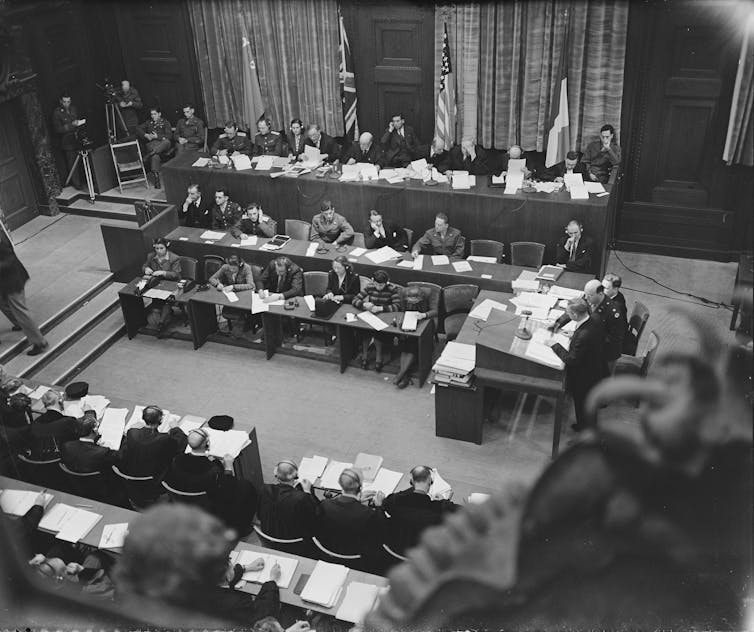
Nuremberg trial, Dec. 4, 1945.
Sepia Times/ Universal Images Group via Getty Images
Germany used its own national interests as sufficient reason to initiate deadly force against other nations. In so doing, said Jackson, it engaged in a crime for which individual criminal punishment was an appropriate response.
In the course of this crime, Jackson noted, Germany had shown a willingness to ignore both international law and its own previous commitments – and had given itself “a reputation for duplicity that will handicap it for years.”
Jackson asserted, further, that the extraordinary violence of the 20th century required the building of some legal tools, by which the plague of warfare and violence might be constrained.
If such principles were not codified in law, and respected by nations, then the world might well see, in Jackson’s phrase, the “doom of civilization.” Nuremberg’s task, for Jackson, was nothing less than ensuring that aggressive war was forever to be understood as a criminal act – a proposition backed, crucially, by the U.S. as party to the Nuremberg trials.
The morality of warfare
It is fair to say that the U.S, like other nations, has had a mixed record of living up to the legal principles articulated at Nuremberg, given its record of military intervention in places like Vietnam and Iraq.
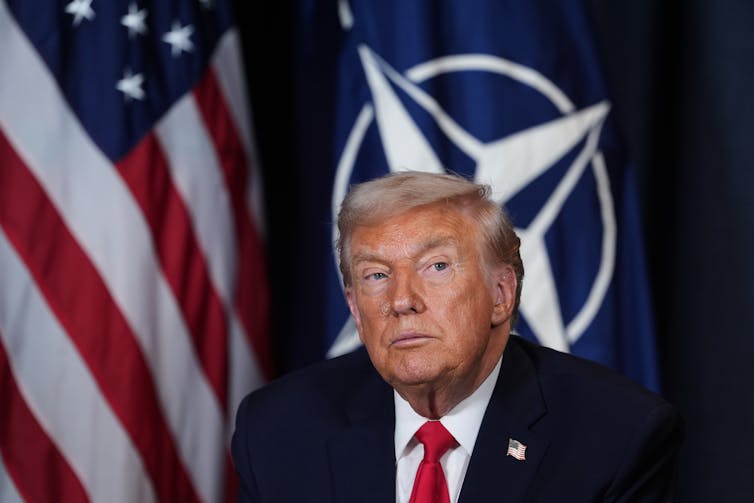
President Donald Trump at the World Economic Forum in Davos, Switzerland, on Jan. 21, 2026.
AP Photo/Evan Vucci
Trump’s prior statements about Greenland, however, hint at something more extreme: They represent an abandonment of the principle that aggressive war is a criminal act, in favor of the idea that the U.S. can use its military as it wishes, to advance its own national interests.
Previous presidents have perhaps been guilty of paying too little attention to the moral importance of such international principles. Trump, in contrast, has announced that such principles do not bind him in the least.
In a recent interview with The New York Times, Trump asserted that he did not “need international law” to know what to do. He would, instead, be limited only by “his own morality” and “his own mind.”
European leaders, for their part, have increasingly decried Trump’s willingness to go back on his word, or abandon previously insisted-upon principles, if such revisions seem to provide him with some particular advantage.
Trump’s statements, however, imply that his administration has adopted a position strikingly similar to that decried by Justice Jackson: The U.S., on this vision, can simply decide that its own moral interests are more important than those of other countries, and can initiate violence against those countries on its own discretion. It can do this, moreover, regardless of either the content of international law or of previously undertaken political commitments.
This vision, finally, is being undertaken in a world in which the available tools of destruction are even more complex – and more deadly – than those available during the Second World War.
It is, indeed, a historic irony that the U.S. of today has so roundly repudiated the moral values it both helped developed and championed globally during the 20th century.
(Michael Blake, Professor of Philosophy, Public Policy and Governance, University of Washington. The views expressed in this commentary do not necessarily reflect those of Religion News Service.)

Original Source: