(RNS) — When worship services at Cities Church in Minneapolis were interrupted by protesters demanding the resignation of a lay pastor at the church who is involved in U.S. Immigration and Customs Enforcement work, some faith leaders and Trump administration officials were quick to label the protests a threat to religious liberty. President Donald Trump himself argued that the protesters should face harsh penalties. Two of the group have since been arrested.
The church, a Southern Baptist congregation, condemned the demonstration, saying protesters had “accosted members of our congregation, frightened children, and created a scene marked by intimidation and threat.” Other Christian leaders also rebuked the protesters, calling their actions “unspeakably evil,” and an activist siege against America by the political left.
Kevin Ezell, the president of the Southern Baptist Convention’s North American Mission Board, defended Cities Church in more measured terms: “No cause — political or otherwise — justifies the desecration of a sacred space or the intimidation and trauma inflicted on families gathered peacefully in the house of God,” Ezell said in a statement.
Ezell has a point, and insofar as Christian critics of the protest are upset about the disruption of Christian worship and communal life by outside forces, they make an important point too. Nobody wants their family or kids to be terrified in church.
But as I read and watched various responses to the protest, all I could think about was how numerous other churches the nation over have experienced threats and intimidation, not from a handful of yelling protesters, but from masked government agents with guns. In the United States today, the overwhelming threat to the church and Christian community is not protest of ICE, but ICE itself.
Consider one story, emblematic of many others. In November, a church volunteer workday in Charlotte, North Carolina, was raided by federal agents. The agents showed no identification, took one man away and attempted to grab other attendees, who escaped only by running into nearby woods. Women and children inside the church sobbed in fear, and the church suspended future services until congregants felt safe. “Right now, everybody is scared. Everybody,” the pastor said.
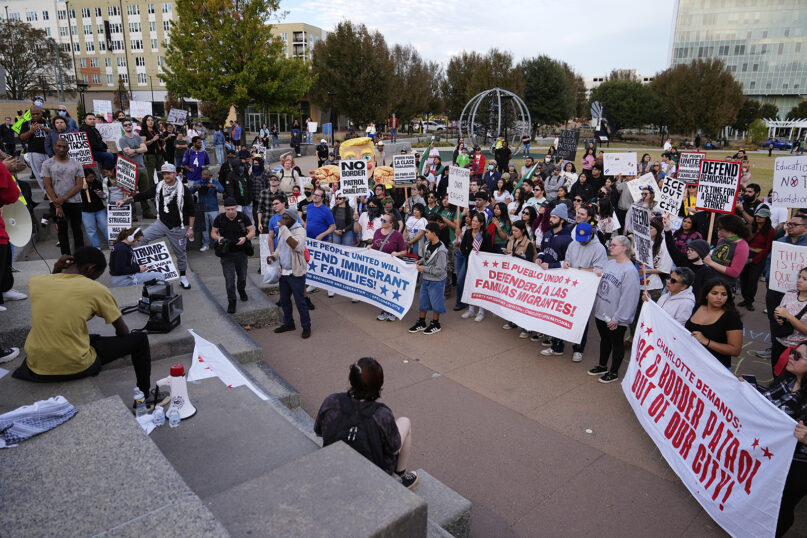
Other churches have reported massive decreases in attendance by immigrant members when ICE is rumored to be in town. One pastor of a majority immigrant church in Minneapolis noted the consequences of ICE’s aggressive presence: “We usually have two full services on the weekend, we’ve been having only one service, half empty,” he said. “Even people that are born here are scared to go out. They don’t want their kids to go through the trauma, stopped by ICE, that kind of thing.”
Yet the Christians who typically bemoan the government’s threats to authentic Christian faith are mostly silent about this rampant ecclesial distress in communities targeted by ICE. Instead, echoing the views of the Trump administration, they persist in casting the popular Christian narrative of aggressive immigration enforcement as biblically justified.
To more fully understand the threat posed to Christian worship and communal life today, American Christians need a better understanding of the church. We need a more robust sense of our sacred connection to one another.
Though we worship in local congregations, Christians believe we are bound together in the body of Christ and that this connection transcends the claims of nationality, ethnicity, family and other earthly allegiances. This fellowship does not vitiate these claims, which can be sources of goodness and meaning. Nor does it mean Christians should live with no respect for earthly allegiances (even the ones we might find suspect). It just means that, at a fundamental level, we see the waters of baptism as more determinative for our identity than anything else.
As the Apostle Paul famously said in his Letter to the Galatians, “There is neither Jew nor Gentile, neither slave nor free, nor is there male and female, for you are all one in Christ Jesus.” It’s precisely this powerful notion that has led Christians, at their best, to engage in mission and service across cultures and national boundaries. Our common Christian bond isn’t the full story of Christian service or politics, of course, but it’s an important starting point for naming our deepest allegiances.
Indeed, this is what Cities Church itself claimed in a public statement following the protest. The church said it welcomed respectful dialogue about challenging public issues, but pointed to a more fundamental commitment: their allegiance to Jesus Christ. Jesus “offers a love that transcends cultures, borders, policies, and politics. … we will not shrink from worshiping Jesus, nor will we stop ‘teaching and proclaiming the good news that Jesus is the Messiah,’” the church wrote, quoting the Book of Acts.
Amen. This is precisely why Christians across the country (and around the world) should ask hard questions about the work of ICE and its harmful impact on Christian communities who worship the same Lord. Christians should reject double standards when we identify threats to Christian worship and community in this country. In striving to deepen our connection and accountability to our brothers and sisters, especially those on the margins, Christians can challenge xenophobic beliefs and violent policies.
To be clear, this sense of connection, borne out of allegiance to Christ, doesn’t offer a particular social strategy or mode of policy engagement, on immigration or anything else. The church simply is a social ethic. We are a community of truth-telling about God and God’s purposes for the world, which happen to also be a rebuke to the idolatry of nationalism and its pathetic renderings of peace through violence.
As Christians, with this sense of confidence and connection, let’s notice when our brothers and sisters don’t show up to worship. Let’s notice the patterns of intimidation and fear in the American church. Let’s confess our sins of failing to notice and love our vulnerable neighbors and our fellow believers.
And let’s respond by doubling down on the work of hospitality and public witness that exposes injustice, defying anything that stands in the way of us perceiving and receiving Jesus in “the least of these.” In doing this, we can offer something constructive to a broken world: a witness to the good news of God’s kingdom, where those who follow Jesus are all one.
(Aaron Griffith is assistant professor of American church history at Duke Divinity School. He is also the author of “God’s Law and Order: The Politics of Punishment in Evangelical America.” The views expressed in this commentary do not necessarily reflect those of Religion News Service.)
Original Source: