(The Conversation) — In many religions and cultures, women who are menstruating or who just gave birth are not allowed to enter sacred sites, such as temples, or participate in religious rituals. This is because they are often seen as ritually impure.
Early Christians cited menstruation as the reason for not allowing female deacons or priests. Modern Catholic teachings do not express this attitude directly, but some Catholic feminists argue that views of women’s blood pollution still influence the church’s position against women’s ordination.
According to certain Hindu texts, menstruating women should be cut off from the rest of the household and avoid participating in ritual life. In Hinduism, as well as other religions and cultures, traditional taboos related to menstruation and childbirth are, however, no longer practiced widely.
An extreme attitude toward the ritual pollution of menstruation and childbirth appears in a Chinese Buddhist text called the “Blood Bowl Scripture,” which I have studied in my research on East Asian Buddhism.
This text, written in China by the 13th century, spread to Japan soon after. It describes a complicated chain of events in which a woman gives birth at home, then washes her bloody clothes in a nearby river. People downriver don’t realize that the water has been polluted with the blood of childbirth, and they use the water to make tea that they offer to the gods. As punishment for offending the gods with tainted water, the woman who gave birth is condemned to fall into the “Blood Pond Hell” after she dies.
Rebirth in the hells is one possible form of reincarnation in Buddhism, which teaches that the quality of people’s karma in their present life determines where they are reborn in their next life. The “Blood Pond Hell” is one of many kinds of hells found in traditional Buddhism. According to Buddhist worldviews, people are reborn in the hells when their bad karma severely outweighs their good karma. However, after people serve their time in the hells, they can be reborn in other realms.
Japanese Buddhists expanded on this idea to claim that the pollution of menstrual blood alone led to rebirth in the Blood Pond Hell, which condemns all menstruating women to this kind of suffering.
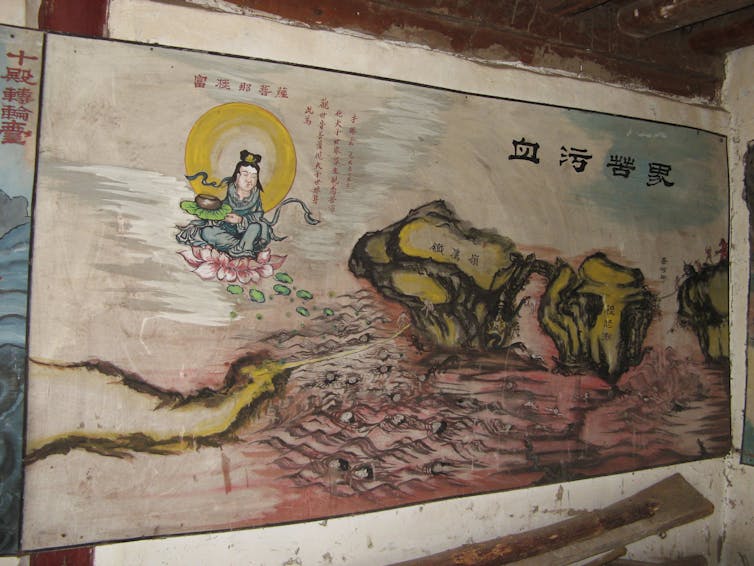
Mural depicting the hell of blood and filth, Dizang Temple, Yunnan, China.
Megan Bryson, CC BY
Most educated Buddhist monks in premodern China rejected the Blood Bowl Scripture because it didn’t come from India. Buddhism originated in India, and Buddhist scriptures are supposed to be the words of the Buddha, so the Blood Bowl Scripture was not included in official scriptural catalogs. But the text and its practices became an important part of popular Chinese Buddhism.
For example, a famous Chinese novel from the 17th century, “The Plum in the Golden Vase,” describes its female characters practicing rituals based on the Blood Bowl Scripture.
Blood Pond Hell beliefs and practices still exist today. However, they are not as common as they used to be – and women have developed new interpretations.
Beliefs in modern China
For most women in human history, giving birth has been a requirement, not a choice. Yet, for women in premodern China and Japan, fulfilling the social obligation to have children simultaneously condemned them to “Blood Pond Hell.”
The “Blood Bowl Scripture” encourages adult children to hire Buddhist monks to perform rituals that will save their mothers from this unpleasant fate.
How hell realms are interpreted in Buddhism.
Though not all Buddhists today believe in the hells, including the “Blood Pond Hell,” some do. Visitors to temples and Buddhist theme parks in Asia may find paintings or three-dimensional dioramas of women in a bloody pond.
People who do not believe in the hells may still perform the rituals to save their mothers from the “Blood Pond Hell” to show love and gratitude. In some parts of China, women preemptively save themselves from the “Blood Pond Hell” by performing their own rituals, usually as part of women’s religious associations.
Emphasizing mothers’ self-sacrifice
In many parts of China, middle-aged and older women form voluntary religious associations. The religious associations get together twice a month and on holidays to recite scriptures, make offerings to the gods and go on pilgrimages to sacred sites.
Most women who participate are already menopausal, with grown children. Pre-menopausal women are allowed to participate if they aren’t menstruating.
In the religious associations of southeast China’s Fujian province, women perform a ritual called “Returning to the Buddha” that aims to purify them of bad karma before they die. In this ritual, women atone for different kinds of bad karma, which includes spilling the polluted water they used to clean up after childbirth.
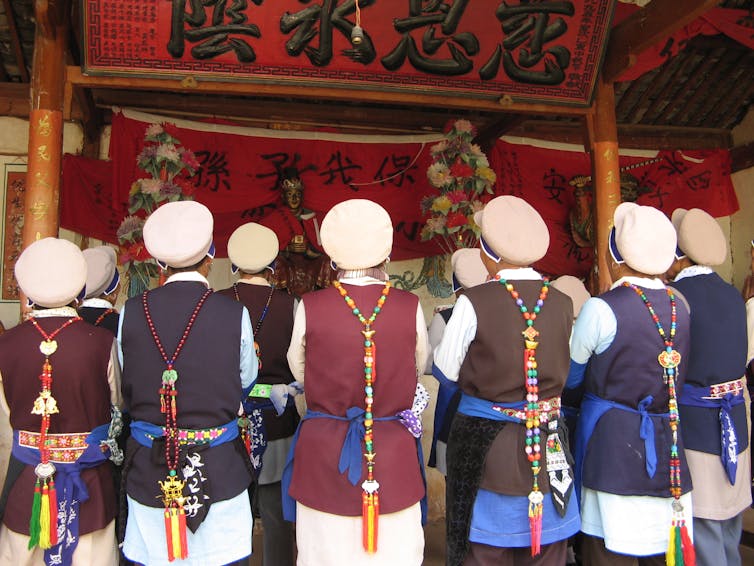
Women reciting scriptures together while facing a statue of their main temple’s deity in southwest China.
Megan Bryson, CC BY
Women’s religious associations across China also recite scriptures to repay mothers’ kindness. Reciting scriptures is seen as creating good karma, which the women dedicate to their mothers. These scriptures still portray uterine blood as polluting, but they also recognize the sacrifices mothers make in bringing their children into the world.
One such scripture describes how mothers sacrifice for their children first in life, then in death when they fall into the “Blood Pond Hell.” The women who recite these texts both express gratitude for their mothers’ sacrifices and recognize their own sacrifices as mothers.
Reframing the female body
In addition to reinterpreting the “Blood Pond Hell” through the lens of mothers’ sacrifice, women in modern China have developed new interpretations of how female bodies are portrayed in “Blood Pond Hell” beliefs and practices.
Buddhist texts often claim that being reborn as a woman is a karmic punishment, and some texts describe female bodies with disgust. For example, a repentance text for saving women from the “Blood Pond Hell” claims that menstruation is caused by 12-headed worms living in the birth canal that vomit blood and pus once a month.
However, in my research I encountered a sermon about this repentance text by the Taiwanese nun Venerable Shi Changyin. She claims that “worms” really meant “bacteria” or “cells,” but premodern people lacked the biomedical terminology to express this properly.
Changyin’s reinterpretation of worms as cells reflects other ways for women to think about the blood of menstruation and childbirth. The negative views of female bodies expressed in the “Blood Bowl Scripture” are one perspective among many in contemporary Chinese culture.
Buddhist teachings that downplay the importance of gender, traditional Chinese medicine, and biomedicine offer other perspectives on reproduction and female bodies. Many scholars and practitioners of Chinese Buddhism reject “Blood Pond Hell” beliefs as remnants of negative attitudes toward female bodies in early Buddhism.
They see Mahayana Buddhism, the main form practiced in China, as promoting gender equality. In traditional Chinese medicine, blood is an important part of women’s health as a source of vitality rather than impurity. And biomedicine avoids concepts like purity and pollution when treating issues related to menstruation and childbirth.
A narrative of empowerment
The “Blood Bowl Scripture” demonizes the blood of menstruation and childbirth and, by extension, reproductive female bodies in general. Yet many women, past and present, have participated in the scripture’s rituals to save their mothers or themselves from this fate.
It is important not to just dismiss women’s participation as internalized misogyny, but to understand what women get out of these practices.
Women in Chinese Buddhism have taken the initiative in emphasizing maternal self-sacrifice over ritual pollution and in using other frameworks to make sense of menstruation and childbirth.
(Megan Bryson, Associate Professor of Religious Studies, University of Tennessee. The views expressed in this commentary do not necessarily reflect those of Religion News Service.)

Original Source: