(RNS) — As she prepared to meet with a woman whose husband had been detained by U.S. Immigration and Customs Enforcement agents in Minneapolis, Rhonda Miska, a communications director at the Church of St. Timothy in Blaine, Minnesota, portrayed it as a public safety intervention in the crisis ICE agents have brought to her city.
“I feel like I get to be like part of the SWAT team that’s just on the ground, available,” said Miska, who as spent more than two decades in Hispanic ministry.
She described a community afraid to leave their homes, go to work and attend school. “There is a lot of fear, there’s a lot of sadness,” said Miska. Besides the risk of being arrested, she said, the immigrants she ministers to despair at being depicted as criminals or rapists. “If people just tell you over and over that you’re terrible and treat you like you’re terrible, it kind of starts to mess with your mind,” she said.
Miska is one of many Minnesota Catholic women who are leading resistance efforts in the Twin Cities area as federal immigration agents have engaged in a large-scale operation that has left the community frightened and indignant after the fatal shootings of Renée Good and Alex Pretti in January.
Catholic leaders in Minnesota and nationally have issued statements calling for prayer, peace and respect for human dignity, with the Minnesota Catholic Conference of bishops saying that immigrants have been “treated as political pawns,” and even Bishop Robert Barron, a Minnesota bishop who serves on President Trump’s Religious Freedom Task Force, calling on the administration to focus on “serious” criminals.
But for many lay Catholics, those responses have felt distant from the reality they are seeing in their neighborhoods. They have begun to stand up for immigrant rights in demonstrations and direct support for the families of those detained.
“I honestly think it’s easier for those of us on the ground as lay people to be prophetic,” Miska said, adding that laypeople are free to take more risks unbound by the responsibility of managing an institution. “There’s a level of flexibility and availability that I have,” she said.
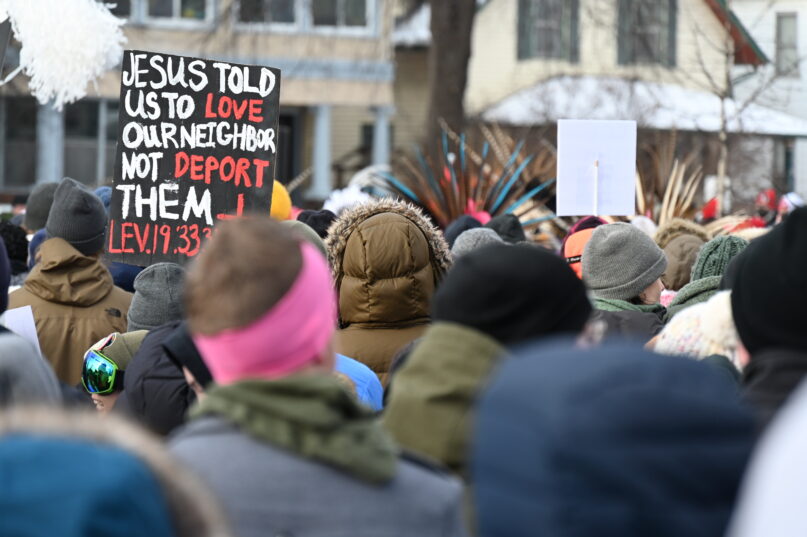
When local Catholics gathered on Jan. 26 at the Basilica of St. Mary, just west of downtown Minneapolis, to organize their response to immigration enforcement operations, several in the crowd lamented what they described as a lack of public opposition by the church’s hierarchy. “The sheep are leading the shepherds,” said Patty Santos, a Spanish-language translator deeply embedded in the Latino communities, at the meeting.
Anne Attea, a pastoral associate for 16 years at majority-Latino Church of the Ascension, in the North Minneapolis neighborhood, said it has been “disappointing” for her to see priests keep quiet about the situation in their parishes. “Our Catholic priests are not out here, and they’re not preaching the reality from the pulpit,” she said.
Since federal immigration officers started Operation Metro Surge, attendance at Ascension dropped precipitously, and only 80 people showed up for the Dec. 12 Feast of Our Lady of Guadalupe, a key celebration for Latino Catholics, down from the usual 400. Only a few dozen gather for the Spanish Mass at the church that is normally so packed that many have to stand.
To help people in the community, Attea and her parish have organized food distribution for families that can’t get out to shop for groceries or can’t afford them due to lost work. The program has helped nearly 300 immigrant families in only three weeks. “One of the biggest things that folks will say is they would love visits, because there’s no interaction with the outside world,” she said, adding that some have not left their home since December.
If the people could not come to church, Attea decided she would bring the church to them. On Feb. 2, the feast of Candlemas, Attea joined 100 others in singing and praying the rosary outside an apartment complex where immigrants had been detained and deported and many more were barricaded inside in fear.
Attea said that as the singing began, most of the windows were closed, with curtains drawn tight. As it continued, people came to their windows, some holding candles. “I have found the singing resistance to be very, very powerful, because it’s about focus. This is what we’re doing. We’re praying and we’re singing,” she said.
Attea witnessed the power of prayer in the experience of a woman who had been detained in Minneapolis and sent to a detention center in Iowa. Attea said the woman, whose name she declined to share, responded to her situation by organizing prayer groups, teaching the rosary and sustaining others. “She said, ‘I feel like that’s what God did, took me to a place where people really needed me,’” said Attea, who had brought the woman back to Minneapolis after her release.
Finding peaceful, non-violent ways to protest the operations of immigration officers has been a goal for Jane Leyden Cavanaugh, a parishioner at St. Joan of Arc Church in Uptown Minneapolis. Cavanaugh has attended numerous protests against ICE enforcement since November, including a Jan. 30 rally in front of the Whipple Federal Building, where ICE’s local offices are housed.
Cavanaugh pointed to the numbers of Catholic women involved, despite women’s traditional lack of formal leadership roles in the church. “In my world, I see women as the agents. I see them as the protagonists. They are essential to this movement,” she said.
Cavanaugh, Attea and Miska are all members of Discerning Deacons, a Catholic network of women who believe they are called to the diaconate and their supporters. The Catholic Church only permits men to be ordained as deacons, who are allowed to preach during Mass, lead funeral services and perform baptisms, but can’t say Mass, hear confessions or anoint the sick.
Last October Discerning Deacons brought almost 100 Latino immigrants to the Vatican to meet Pope Leo XIV and make an appeal for migrant rights. “I think we’re doing good diaconal work without paperwork,” Cavanaugh said.
Pope Francis created two commissions to study the question of the female diaconate, which was also among the main issues raised in his worldwide consultation of Catholics called “Synod on Synodality.” The second commission voted against ordaining female deacons in December, while calling for more study and discernment.
“Catholic women are stepping up as leaders,” said Lisa Amman, a founding staff member of Discerning Deacons and an active parishioner in St. Thomas More Church, in St. Paul.
“We cannot wait to be ordained to respond to the diaconal call on our hearts.”
Original Source: