(RNS) — The new archbishop of Canterbury, Sarah Mullally, made her first presidential address to the Church of England’s governing body Tuesday (Feb. 10) with a promise to make a major priority of protecting church members from sexual abuse — the issue that caused the downfall of her predecessor, Justin Welby.
The church, she said, had “too often failed to recognize or take seriously the abuse of power in all its forms,” and in the past it had fallen “tragically short” on accountability.
Mullally, who in October became the first woman appointed to head of the Church of England, promised: “I am committed to bringing an approach of seriousness and focused direction to all matters relating to safeguarding in all contexts in the church. This approach must be trauma-informed. Put victims and survivors at the heart of all we do and be committed to proper independence.”
The former chief nurse of the United Kingdom’s National Health Service before being ordained, the archbishop served notice that she would focus on putting procedures in place. “Robust and transparent processes are central to the health of any institution. Proper processes around appointments, clear guidelines around conduct and good processes for handling concerns, campaign links and whistleblowing. And nowhere is accountability more imperative than in relation to safeguarding,” she said.
Mullally’s comments on sexual abuse reflected the difficulties on these matters the Church of England and the leaders of the wider Anglican Communion — of whom, as archbishop of Canterbury, she is considered the “first among equals” — have had in recent years. Welby stepped down after a damning report into a serial child abuser with links to the Church of England.
Now, said Mullally, the church “must be willing always for light to be shone on our actions and our decisions. We can only begin to rebuild trust and confidence through openness and integrity.”
The presidential address is a regular item at the Church of England’s General Synod and is a keynote speech, traditionally given by either the archbishop of Canterbury or the archbishop of York, setting out strategy within a spiritual and theological context for the church’s legislative body. But with Mullally speaking for the first time as the first female archbishop of Canterbury, the speech was particularly significant.
Mullally spoke about the role itself, admitting that it is challenging and complex, but said that the call, like that of her fellow bishops, to share hope found in Jesus Christ made it essentially simple.
The thread running through her time as archbishop, she said, would be nurturing confidence and hope, rooted not in institutions but in God and the gospel of Jesus Christ. Despite recent difficulties, she said, she believed “the best is yet to come for the church.”
She suggested she would not be bringing major changes to the Church of England and the Anglican Communion. “I believe that I have been called to love and serve the Diocese of Canterbury, the Church of England and the Anglican Communion, not through developing new programs and initiatives,” she said, “but by being a shepherd, who works collaboratively and in partnership.”
She also acknowledged that the synod, like the rest of the Church of England, has seen intense arguments and division over issues such as same-sex relationships in recent years. Discord between those who favor endorsing such relationships and those vehemently against them has torn the Church of England and the Communion apart. Those arguments continue despite the drawing up of special prayers for blessings of same-sex couples.
Involvement in debate “comes at great cost,” Mullally said, telling synod members, “I see you as you learn to listen more deeply to one another in spite of difference.”
Speaking to those who make up the congregations of her home church, Mullally acknowledged the work done at the parish level “day in and day out,” paying tribute to the way Anglicans live out their calling with “every Eucharist that is offered, with every prayer said, with every child helped to flourish in our schools, with every family cared for in times of celebration and of sorrow, with every night shelter and food bank, with each worship service, youth group, and community lunch, with every effort to work for justice, dignity, and fairness in our nation, and our world.”
But she made no mention of the enormous costs many parishes face to maintain their historic buildings. Last month, the U.K. government announced it would introduce a 92 million-pound fund over four years for historic, listed places of worship. It replaces a 2-decade-old tax relief program for repair and maintenance of historic church buildings, which the government recently scrapped.
Under the new plan, historic churches will have to compete against one another to gain a grant, as well as against other places of worship such as synagogues, mosques and temples. With declining attendance and income, as well as having fewer volunteers to fundraise and fill in complicated government application funds, the new grant system could prove a major headache.
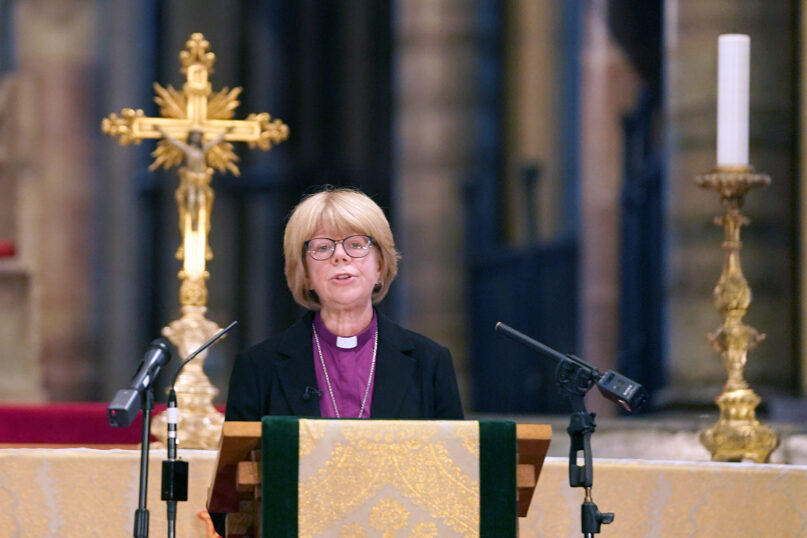
Mullally was nonetheless optimistic about the Church of England’s future, noting that since the COVID-19 pandemic, people have started to attend church again. These increases, she said, were “green shoots of hope.”
“There are early indications of a rise in attendance and participation, having continued over the last year. Of course, we must be cautious. These are early figures, but the trend is clear. People are returning to church. They are finding a welcome friendship, community, meaning and purpose.”
Mullally was ordained as a priest in 2006 and appointed the first female bishop of London — the third most senior member of Church of England clergy — in 2018. Her formal installation as archbishop will take place at Canterbury Cathedral on March 25, the feast of the Annunciation.
At age 63, Mullally can only serve seven years until mandatory retirement at 70 and so may be regarded by some as an interim archbishop. But interim or not, her appointment has been warmly received by the majority of Anglicans. When she rose to give her presidential address at General Synod, held in Church House, the church’s headquarters in London, she announced herself according to the church’s synod number code: Sarah Mullally, 001 Canterbury, to lengthy applause.
Heckling was noticeably absent. At a special legal ceremony for Mullally’s appointment, held on Jan. 26 at London’s St. Paul’s Cathedral, one heckler protested that a female bishop is not found in the Bible. Conservative Anglican leaders around the world, particularly those from the Global Fellowship of Confessing Anglicans, known as GAFCON, argued that Mullally’s appointment was contrary to biblical teaching and ignored the views of many Anglicans worldwide.
But in a Jan. 26 interview, Mullally said she would call out misogyny during her time as archbishop.
“I’m conscious that being in this role, it’s important for me to speak of it, because there are some that don’t necessarily have the status or power of this role and feel more hesitant to do it. I commit myself to making an environment where all people can flourish and which is safer for all,” she said.
Original Source: