(The Conversation) — Louisiana can proceed with a law requiring public schools to display the Ten Commandments, according to a federal court decision on Feb. 20, 2026. The U.S. Fifth Circuit Court of Appeals voted that it is too early to determine whether the requirement violates the First Amendment of the Constitution, which protects religious liberty and prohibits the government from establishing religion. The judges heard arguments in Louisiana’s law and a similar Texas one in January 2025 but have yet to rule on the latter.
One of the plaintiffs in a lawsuit filed against the Texas law is Rev. Griff Martin, a Baptist pastor. Martin has criticized the Ten Commandments mandate as not just a violation of American precepts but religious ones as well. In a press release by the American Civil Liberties Union of Texas, which is representing the plaintiffs, he stated that “the separation of church and state (is) a bedrock principle of my family’s Baptist heritage.”
Speaker of the House Mike Johnson, who represents Louisiana, is also the country’s most prominent Baptist politician – and perceives the matter differently. The Louisiana law is not an effort to establish religion, but to acknowledge the country’s “history and tradition,” he told reporters in 2024.
Baptists have long advocated for religious freedom. But as a scholar of Baptist theology and history, I know that this record is far from simple. In fact, both Martin and Johnson have ample precedent for their opinions on Baptist identity and the relationship between church and state.
Historians and political scientists often divide interpretations of the First Amendment into two broad categories: “separationism” and “accommodationism.” According to separationists, government and religion should have no formal relationship. Accommodationists, on the other hand, believe government depends on and should encourage religion in general – or Christianity, specifically.
An honest look at their history reveals that Baptists have taken various stances in this debate, reflecting their overall diversity.
Call for separation
The phrase “separation of church and state” is famously traced back to an exchange between Thomas Jefferson and a group of Baptists.
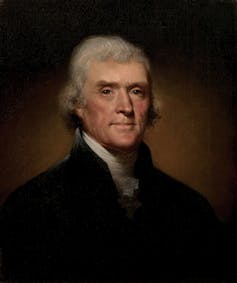
The official presidential portrait of Thomas Jefferson, painted by Rembrandt Peale in 1800.
White House via Wikimedia Commons
.jpg)
After Jefferson’s election as president in 1800, the Danbury Baptist Association in Connecticut wrote a letter of congratulations. Jefferson responded, celebrating their shared beliefs in religious liberty. He cited the First Amendment, which says that “Congress shall make no law respecting an establishment of religion, or prohibiting the free exercise thereof.” In Jefferson’s interpretation, religion is a matter between individuals and God, and so these clauses rightly erected a wall that defended conscience from the government.
But the image of a barrier between church and state is older than Jefferson’s letter. It first appears in the writing of Roger Williams, a radical preacher who founded Rhode Island in 1636. This was the first American colony to grant religious freedom for all people. Williams also helped organize America’s first Baptist church. In one of his works, Williams explained that the “hedge or wall of Separation” protected the “Garden of the Church” from the world.
Baptist separationism goes back to the beginning of the movement. The first Baptists were a group of English exiles living in Amsterdam in 1609. The church split, and part of the community returned to Britain under the leadership of Thomas Helwys.
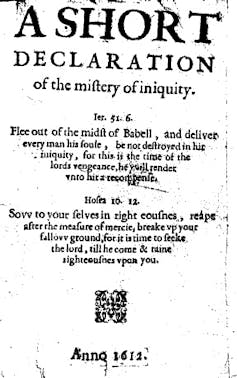
The title page of Thomas Helwys’ ‘A Short Declaration of the Mistery of Iniquity.’
Early English Books Online database/Bodleian Library, University of Oxford/Wikimedia Commons

In 1612, Helwys boldly delivered a book to King James called “A Short Declaration of the Mystery of Iniquity.” In it, he offered the first defense of absolute religious liberty in the English language.
Helwys declared the king was mortal and not God. Therefore, a ruler “hath no power over the mortal soul of his subjects” in matters of religion. He argued for tolerance not just of different Christian sects but other religions and nonbelievers: “Let them be heretics, Turks, Jews, or whatsoever, it appertains not to the earthly power to punish them in the least measure.”
King James had Helwys thrown in prison for his impudence, where he eventually died.
Baptists who argue for strict separation of church and state have done so for several reasons. They believe that the conscience of each individual must be respected. They contend that government is not competent to judge between true and false religion. And they fear that an alliance with state power corrupts the church’s witness to the gospel.
Seeking accommodation
As much as contemporary Baptists quote Helwys, his work was forgotten for many years following his death. In the American Colonies, many people saw Williams’ Rhode Island colony as a land of dangerous anarchy.
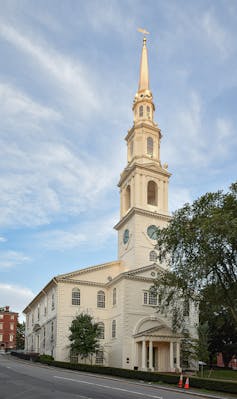
The First Baptist Church in America, located in Providence, R.I.
Filetime/Wikimedia Commons, CC BY-SA

Baptists faced legal obstacles and sometimes violent persecution in colonies with established churches, such as Massachusetts and Virginia. They became fierce advocates for religious liberty during the American Revolution and the framing of the Constitution. But even as they believed in liberty for individuals and churches, many Baptists also believed government should support Christian faith and morals.
A significant figure who illustrates accommodation was Isaac Backus, a Massachusetts pastor. Backus fervently opposed taxation to benefit the Congregationalist Church in some New England colonies. But he also felt that the state should reflect shared religious tenets. As a result, he endorsed various morality laws, religious tests for office and the government printing of Bibles.
Baptists who support accommodation – the idea that government should cooperate with religion – tend to see the United States as a Christian nation, not simply a nation with Christian citizens. Today, 63% of Americans identify as Christian.
Second, they argue that successful governance relies on the population being virtuous, and that the best guarantee of virtue is practicing Christianity.
Religious faith as a prerequisite for civic stability was a common belief in early America. George Washington expressed this view in his farewell address.
Johnson advocates a similar perspective today. In a 2022 lecture at Louisiana Christian University, the Baptist college that formerly employed him, Johnson asserted that God lies at America’s foundations, and decline has occurred because biblical morality has been abandoned. He has also declared in a social media post that “just government” depends on the fear of “eternal judgment.”
Divided by faith
Are you a good Baptist if you oppose government-mandated displays of the Ten Commandments? Or are you a good Baptist if you support them? From a historical perspective, the answer to both questions is yes.
Religious liberty and church-state separation remain contested concepts not just politically but theologically. Some Baptists support a neutral government and the full equality of religious minorities. At the other end of the spectrum, a few explicitly embrace Christian nationalism.
The historian Barry Hankins proposed that Baptists’ opinions on church and state depend on their perceptions of culture. Separationists see themselves comfortably finding their place in a pluralistic society. Accommodationists, meanwhile, worry that a secularized country will curtail the free exercise of religion.
On this issue, and many others, I believe Baptists will long remain a people divided by their shared faith.
(Christopher Schelin, Assistant Professor of Practical and Political Theologies, Starr King School for the Ministry . The views expressed in this commentary do not necessarily reflect those of Religion News Service.)

Original Source: