(The Conversation) — Today’s youth cherish “authenticity,” but is it a virtue? According to a report from Ernst & Young, more than 9 in 10 Gen Z respondents indicated that being authentic and true to yourself is extremely or very important. In fact, most of them claimed authenticity is more important than any other personal value.
This finding is not all that surprising: All of us live in an age where we’re bombarded by social media and artificial intelligence – when striving to be your authentic self becomes an increasingly difficult task.
Yet, even if it has somehow become a common goal, it is unclear how many of us can truly define the “authenticity” that we say we are pursuing. I think it’s also worth asking whether sincerity and authenticity are perennial human virtues or just obsessions of this technological age.
As a scholar in the history of political thought and American political development, I think two philosophers can help us understand this problem and how to deal with it: Jean-Jacques Rousseau and Martin Heidegger.
Sincerity: A counter to modernity
Rousseau, the 18th-century philosopher from Geneva, arrived in the wake of earlier Enlightenment philosophers, such as Hobbes, Locke and Montesquieu.
These thinkers laid many of the foundations for how people understand liberal democracy today, especially the emphasis on individual natural rights – to paraphrase Thomas Jefferson’s later formulation, all human beings are “endowed” with these rights at birth or by nature. In particular, Hobbes popularized the idea of generating a commonwealth in order to escape the uncertainty in a state of nature where self-preservation is fundamental. Locke also emphasized the right to property, while Montesquieu saw the importance of international commerce, among other aspects, including the separation of powers.
But Rousseau became famous for his criticisms of the individualistic civil society born out of their thought. In the modern commercial republic, the fixation turned to luxury rather than duty. “Ancient politicians spoke incessantly about morals and virtue,” he wrote; “those of our time talk only of business and money.”
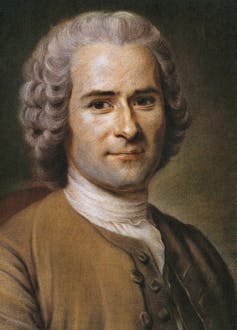
A portrait of Rousseau by Maurice Quentin de La Tour.
Musée Antoine-Lécuyer/Wikimedia Commons
.jpg)
For Rousseau, modern society was a conformist “herd” where everyone hides behind a “veil” of politeness. People wear masks to hide their selfishness, deceiving others in order to satisfy their own desires.
In this way, he argued, human beings are actually enslaved to each other: While each person pursues self-interest, success requires getting others to see some “profit” in helping each other. The rich need the “services” of the poor just as the poor need the “help” of the rich. Anyone who refuses to yield to this entire enterprise “will die in poverty and oblivion.”
Sincerity is the path to self-realization in Rousseau’s political philosophy, according to political science professor Arthur Melzer. As Melzer states, “We want, as fully as possible, to become what we are, to realize ourselves, to become as alive and actualized as possible, to really live.” For him, Rousseau considered sincerity to be what puts us on “the path” to true human excellence. It’s the “countercultural virtue” needed to oppose the hypocrisy found in modern society.
Authenticity: Uncovering the self
While Rousseau extolled sincerity, 20th-century German philosopher Martin Heidegger significantly influenced today’s understanding of a related idea: authenticity.
In his magnum opus, “Being and Time,” Heidegger considered how the self gets lost in the public world. In everyday life, individuals think and exist in terms of the other people they encounter – a way of being he called the “they-self.” He stated, “Everyone is the other, and no one is himself.”
Heidegger believed that people are inauthentic when they’re driven into “uninhibited hustle” within the world, tranquilizing themselves from anxiety about the true meaning of human life and its eventual end.
In his later work, Heidegger argued that everything and everyone in contemporary life had become technological, treated as raw material for “exploitation.” For example, in the technological age, the Rhine River is not a “river” but merely “something at our command,” a supplier of “water power.”
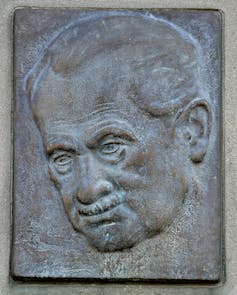
A memorial to Heidegger at the Heidegger House in Messkirch, Germany.
Andreas Praefcke/Wikimedia Commons, CC BY

“Everywhere everything is ordered to stand by, to be immediately at hand,” he claimed, “indeed to stand there just so that it may be on call for a further ordering.” This extends even to human beings themselves, now referred to as “human resources.”
By contrast, the authentic human being is called to choose and be the self, rather than being for the sake of others. They don’t flee death, and in discovering the world in this way, it feels like clearing away “concealments and obscurities.”
Still, Heidegger did not explicitly say that authenticity is human excellence or the “highest good.” As political philosophy professor Mark Blitz articulates, Heidegger’s authenticity is the “true understanding of what human beings actually are.” From this perspective, authentic human beings are able to confront and grasp the responsibility they have for their own existence.
Bound by justice
Despite the current obsession with sincerity and authenticity, I believe it’s important to put these concepts in perspective: They might be added to a list of classical virtues, including courage, moderation, justice and prudence, rather than completely replacing them.
There may be nothing intrinsically dangerous about pursuing authenticity. In many cases, it’s clear that people ought to be left to be who they want to be. But there are still a few obvious limits.
At the very least, authenticity must be bound by justice. What if someone being their “authentic self” harms the environment or others? Some people are “sincere” or “authentic” while committing all kinds of harmful actions.
While each of us may pursue authenticity, we should also remember that just and peaceful relations require the celebration of both difference and mutual respect.
(Kenneth Andrew Andres Leonardo, Postdoctoral Fellow and Visiting Assistant Professor of Government, Hamilton College. The views expressed in this commentary do not necessarily reflect those of Religion News Service.)

Original Source: