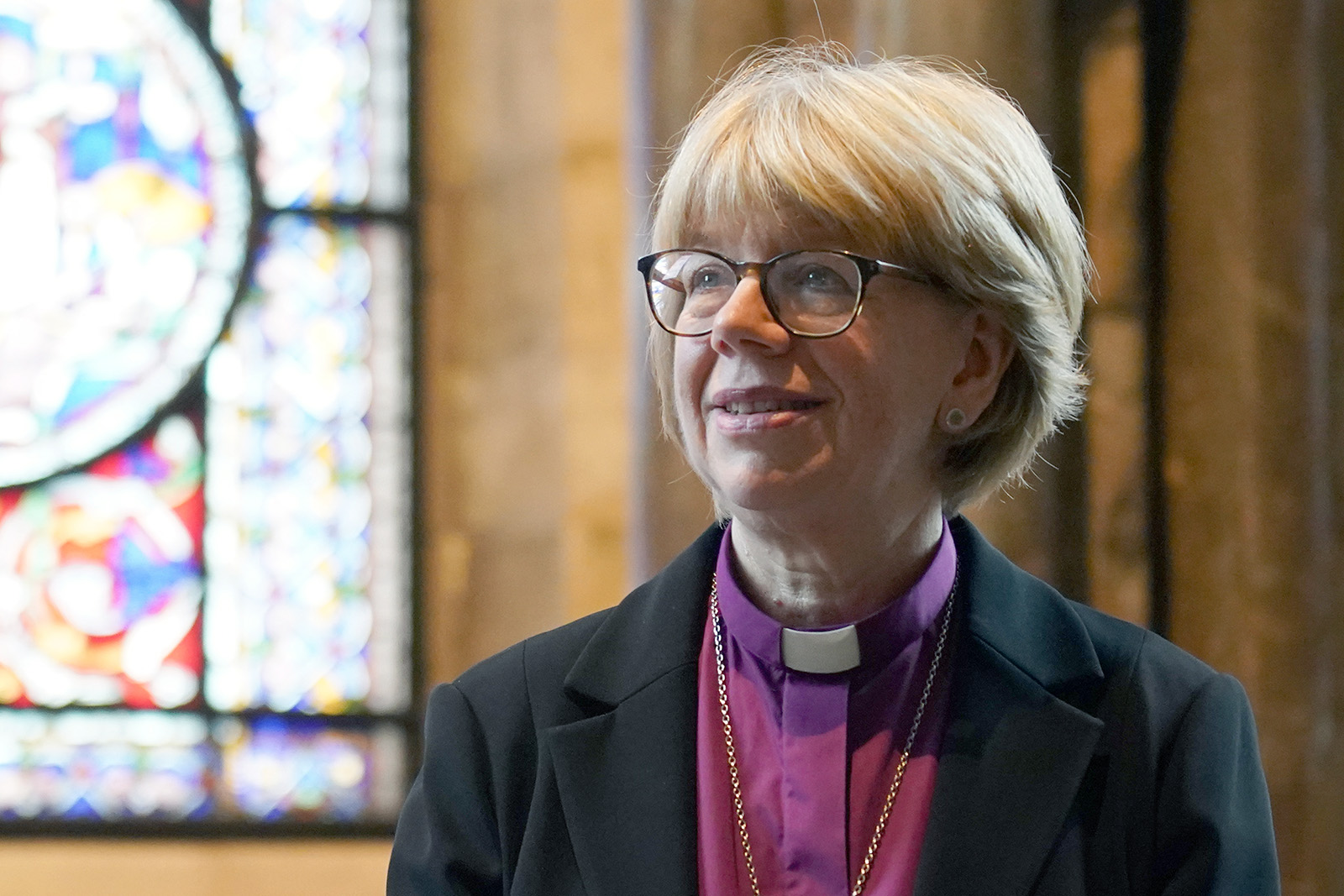
LONDON (RNS) — When Sarah Mullally is installed as the 106th archbishop of Canterbury on Wednesday (March 25), it will be an extraordinary occasion not only for the most obvious reason that she is the first woman ever to lead the Church of England and serve as convener of the Anglican Communion: As a former chief nurse of the United Kingdom’s National Health Service, Mullally is also the first archbishop of Canterbury to have led a major public agency in the country.
In the congregation at Canterbury Cathedral in Kent on Wednesday, along with royals, politicians, clergy from around the world and schoolchildren, will be representatives from the NHS, testifying to Mullally’s accomplishments before she was ordained in 2002.
In another first, at least in recent memory, she took part in a pilgrimage, walking the 87 miles from St Paul’s Cathedral in her London diocese, where she has been bishop since 2018, to Canterbury.
But it is Mullally’s gender that will be the most remarked upon part of her ascent, from her birth in Woking, southwest of London, and her beginnings as a nurse at St. Thomas Hospital in central London to “first among equals” among Anglican bishops. Her groundbreaking first will be emphasized by taking place on the Feast of the Annunciation, with its theme of Mary saying yes to the calling of God to be the mother of Jesus, according to the Gospel of Luke.
Several primates from the worldwide Anglican Communion have said that they will boycott the installation to express their disapproval of a woman at the helm and Mullally’s welcoming stance toward LGBTQ+ members of the church. But the public interest in her appointment has caused huge interest in Britain’s social media and news outlets. The BBC plans to broadcast the installation service live and in full on Wednesday.
The pilgrimage, meanwhile, accentuated Mullally’s sometimes twisting journey to Canterbury, which may never have been completed if it hadn’t been for an Anglican organization called Leading Women. Little known but highly influential in British women’s incremental rise in church leadership, the group mentored women who had the potential to be bishops.
After the first women were ordained priests in 1994, the Church of England’s General Synod agreed in 2006 that women should join the episcopate: This decision was ratified two years later. But there was a feeling among women clergy that leadership roles would remain out of reach unless they prepared for the responsibilities that entailed, from pastoral relationships with the laity and the clergy to managing historic buildings to coping with budgets.
The Revs. June Osborne, then dean of Salisbury; Lucy Winkett, precentor at St Paul’s Cathedral; Keith Lamdin, principal of Sarum College, Salisbury; and Jane Shaw, dean of divinity at New College, Oxford, launched Leading Women as a yearlong mentoring program in 2010. Besides the practical questions, there were conversations about ambition conflict and Christ-like leadership, as well as advice from women already serving as bishop in the United States and elsewhere in the Communion.
The founders recognized that in addition to developing women’s confidence, the program needed to help them deal with the prevalent attitudes of men in the church at the time. Christina Rees, who had been involved in campaigning for women’s ministry in the Church of England for many years, recalled that: “What people don’t understand is the impact of hundreds of years of patriarchy and male entitlement and micro-aggressions. They can make women feel that there is something wrong with them, contributing to imposter syndrome.”
Shaw, now a professor of the history of religion at Oxford University, recalled, “We wanted to help women develop skills, so we had sessions on leadership, including the theology of leadership, but also dealing with money and managing change. We also wanted women to understand what their gifts were, and what transferable skills they might have from previous work experience.”
Somebody who undoubtedly had transferable skills was Mullally, who joined Leading Women’s second cohort in 2012. By then, she was one of a team in Sutton, in London’s outer suburbs, leading three parishes.
Two months after the Leading Women course, a vacancy arose for a canon treasurer at Salisbury Cathedral. Osborne encouraged Mullally to apply. It was her first step into church leadership, followed shortly by her appointment as Bishop of Crediton in 2015, which led to the highly prestigious See of London.
Shaw said that mentoring women went beyond teaching leadership skills. Many needed help understanding what their roles might be. “It was also a question of vocation, about discernment of their vocation, and giving them the space to do that.”
All this work was going on as many in the church opposed their vocations. Many still do not recognize women bishops or even women priests. “Flying bishops” are still supplied to parishes to ordain priests when the congregation does not want a woman to do so.
Mullally has acknowledged more than once how hard it is to be a woman leader. In February 2025, she addressed the General Synod of the Church of England about appointments to senior roles, saying, “I would love to trust people to do the right thing, but the truth is that women continue to be underrepresented,” adding, “I would love to encourage women, which I do all the time, but there continues to be institutional barriers, we continue to experience micro-aggressions,” before breaking down in tears.
After retaining her composure, she was applauded loudly and given a standing ovation, mostly from women. Eight months later, in October 2025, she was appointed to the top job at Canterbury.
Sometimes overlooked is another break Mullally represents from the traditional elite network of Anglican bishops educated at private schools and “Oxbridge” — the universities at Oxford and Cambridge that are the breeding grounds of British leaders of all sectors. But if any institution can benefit from new perspectives from leadership, it’s the Church of England. Fewer than a million people attend its Sunday service — attendance at Roman Catholic Masses, the very denomination it was founded to replace, recently overtook it. The high proportion of the church’s buildings date to the medieval period, and the cost and complexity of running such historic buildings create very present anxiety for church leaders.
Meanwhile arguments between traditionalists and liberals over how to deal with same-sex relationships, including those of clergy, are often toxic. The question of how to handle cases of sexual abuse and responding to survivors — the issue that led to the resignation of Justin Welby, Mullally’s predecessor — is also very much alive.
Even the Church of England’s status as the UK’s established church — it crowns the country’s monarchs, and 26 bishops sit in Parliament’s upper chamber — is controversial. Last week, as she walked the road to Canterbury, Mullally rushed to a high-profile vote in the House of Lords on the decriminalization of abortion for mothers who have performed abortion on themselves. (Mullally voted against it, but the amendment passed.)
At the same time, a parliamentary body called the Ecclesiastical Committee blocked Church of England plans to reform its structures. The ministers on the committee argued that a new body the church wanted to create would be unaccountable to Parliament — a sign of how seriously Parliament takes its role in the church.
Britain’s church has traditionally been a church of compromise, whose high-church Anglicans and Anglo-Catholics lived cheek-by-jowl with evangelicals. But as the former adopt strongly progressive thinking on church teaching, the divides are increasingly apparent. The same split is growing in the worldwide Anglican Communion. Justin Welby criss-crossed the globe trying to hold it together, but Mullally’s knowledge of it is relatively limited. She will now have to try to keep together a Communion where many do not accept her very self, much less her stances.
On her appointment, a statement from the Global Anglican Future Conference, known as GAFCON, said: “Though there are some who will welcome the decision to appoint Bishop Mullally as the first female archbishop of Canterbury, the majority of the Anglican Communion still believes that the Bible requires a male-only episcopacy. Therefore, her appointment will make it impossible for the archbishop of Canterbury to serve as a focus of unity within the Communion.”
Mullally will turn 64 the day after her installation. She will have just six years to unite and revive her church before the mandatory retirement age of 70. If this former chief nurse manages in that time to heal such a divided body, it will be nothing short of miraculous.
Original Source: