(The Conversation) — Toward the end of Netflix’s “Into the Manosphere,” documentary filmmaker Louis Theroux chats in Marbella, Spain, with British influencer Ed Matthews.
“The people who run the world, they don’t have our best intentions,” says Matthews, speaking in the language of the manosphere – where some influencers and viewers believe they have tapped into a deeper truth about reality and power. When Theroux asked who controlled all of that, Matthews shrugged and answered this complex question very simply: “The Jews.”
It’s part of a three-minute digression from the film’s focus on masculinity, with multiple influencers making antisemitic claims about global conspiracies.
The manosphere is a catchall term for websites, forums, blogs and influencers promoting a particular kind of hypermasculinity, from the belief that women and feminism are the cause of men’s problems to calls to legalize rape. Groups within it – including pickup artists, men’s rights groups and “involuntary celibate” or “incel” communities – portray themselves as victims of modernity. In their eyes, the global economy is to blame for their unsatisfactory job prospects, feminism is to blame for their failures with women, minority rights are forcing them to relinquish their privilege as straight men, and so on.
And those digital spaces are rife with antisemitism. Some prominent influencers openly deny the Holocaust, call for violence against Jews and spread global conspiracy theories.
Louis Theroux’s documentary, which debuted in March 2026 on Netflix, follows online personalities shaping young men’s ideas of masculinity.
As a historian of Jewish gender and antisemitism, I know the connections between misogyny and antisemitism have deep roots. For centuries, a frequent tactic of antisemitism has been to attack Jewish men, deriding their masculinity.
Centuries-old tropes
Throughout the Middle Ages and into the 20th century, empires and nations across Europe established laws and practices that held Jewish men apart, not allowing them access to full citizenship. In many areas, Jews were not allowed to vote, to own land, to hold public office, to hold rank in the military or to duel with their peers.
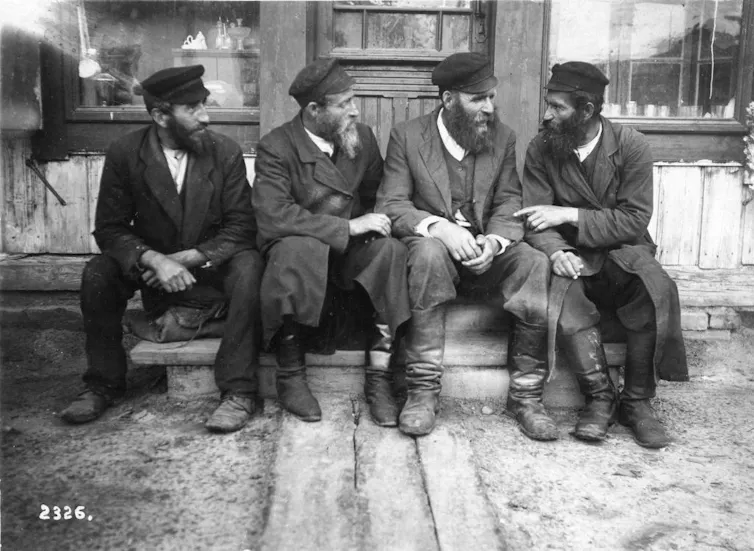
Jewish men chat outside a shop in Krasilov, Ukraine, in the early 1900s.
History & Art Images via Getty Images
Antisemitic rhetoric often portrayed Jewish men as feminine or fragile, and inherently different. Those beliefs extended into the most severe antisemitic tropes and beliefs. For example, the blood libel, which falsely claims that Jews require the blood of gentile children to make their Passover matzo, was frequently linked to a lesser-known antisemitic claim: that Jewish men menstruated and therefore needed the blood of gentiles to replenish themselves. Other antisemitic beliefs claimed that Jews were too weak and cowardly to fight in the military, that they were dominated by Jewish women, or that circumcision made them more akin to women themselves.
The Austrian philosopher Otto Weininger would have fit in well on a manosphere podcast. He excoriated Jewish manhood along with his misogynistic views of women in his 1903 book “Sex and Character.” “Just as in reality there is no such thing as the ‘dignity of women,’ it is equally impossible to imagine a Jewish ‘gentleman,’” he wrote, allowing that even “the most superior woman is still infinitely inferior to the most inferior man.”
American soil
Immigrants to the United States, Jewish and non-Jewish alike, were shaped by these ideas and experiences.
The European Jews who settled in America in the 19th and 20th centuries largely made their way in commerce and trade and tended to settle in cities. At the time, however, the frontier – with its rugged cowboys, miners and railroad men – defined American manhood.
New Jewish arrivals, coming from European nations that had limited Jewish male participation in so many areas, had developed an alternative masculinity, focused on devotion to learning and on “eydlkayt” – a Yiddish word meaning gentleness and sensitivity. After arriving in the U.S., some Jews remained devoted to this form of manhood, but others fought to acculturate and access the more mainstream forms of masculinity they had been barred from in their or their parents’ countries of origin.
One of the earliest of American masculinity influencers was President Theodore Roosevelt, who touted his own transformation from a timid, effeminate man – local presses mocked him in his early career – to a rugged outdoorsman. “The great bulk of the Jewish population … are of weak physique,” he wrote in 1901. Though he blamed this on centuries of oppression, he saw it as a tangible difference discernible in the Jewish body and spirit. Roosevelt advocated a model of redemptive manhood through rugged outdoorsmanship and the strenuous life, and saw masculinity as a means to dominate and control races he deemed inferior.
Jews arguably enjoyed more rights in America than anywhere else in modern times, but they were still excluded from institutions of masculine camaraderie. Well into the 20th century, Jews were restricted from joining prestigious athletic clubs, fraternal societies, high military ranks and country clubs, though some responded by forming their own venues, like the City Athletic Club of New York. Most of these restrictions concluded with the end of Jewish quotas in U.S. higher education in the 1960s and 1970s.
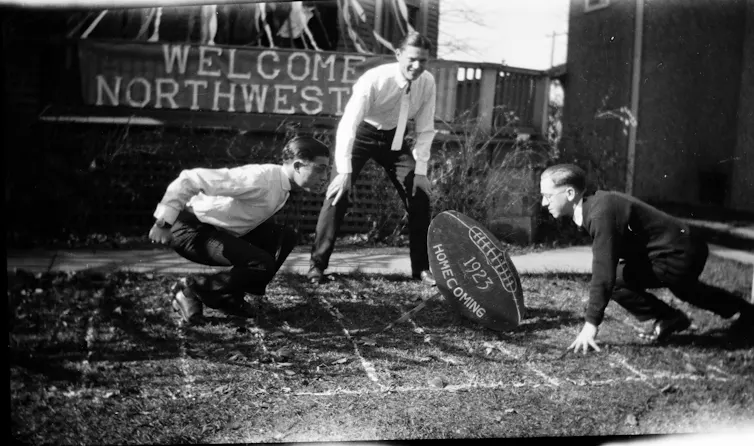
Jewish fraternity brothers, including the author’s great-grandfather, Ezra Sensibar, right, pose for a Northwestern homecoming celebration in Evanston, Ill., in 1923.
Sensibar Family Collection/Miriam Mora
Conspiracies today
Today’s manosphere not only builds on this legacy but also presents something new. Its embrace of antisemitic conspiracy theories allows men who see themselves as victims to explain multiple grievances at once without confronting their own shortcomings.
More than two decades ago, the Southern Poverty Law Center identified a conspiracy theory emerging on the American right: the belief that “cultural Marxists” were intent on destroying American culture. In particular, some proponents blamed Jews for planting progressive ideas and movements, including feminism and gender identity, as part of efforts to weaken white men’s dominance.
This is blatant in the manosphere rhetoric, when figures like Myron Gaines blame Jews for what they see as destructive forces to Western civilization, from feminism and communism to pornography.
Michael Broschowitz, a researcher at the Middlebury Institute’s Center for Terrorism, Extremism, and Counterterrorism, explains the manosphere’s tilt into antisemitism as the result of three driving forces. First, antisemitism serves as a one-size-fits-all answer, claiming to explain lots of problems at once. Second, algorithms designed to maximize engagement amplify extreme content. Lastly, global online communities can quickly remix antisemitic ideas to fit different cultures.
All three of these explanations are important. But I would argue that there is a crucial piece missing: Masculinity and antisemitism have been traversing the centuries hand in hand. The conspiratorial thinking that blossoms in the manosphere blames Jewish men for weakening masculinity. Because in the manosphere, failures of manhood are never your own.
(Miriam Eve Mora, Managing Director of the Raoul Wallenberg Institute, University of Michigan. The views expressed in this commentary do not necessarily reflect those of Religion News Service.)

Original Source:
https://religionnews.com/2026/04/06/why-the-manosphere-has-an-antisemitism-problem/