(RNS) — The Catholic Diocese of Las Cruces, New Mexico, signaled in a legal filing it intends to fight the Trump administration’s fast-moving attempts to seize its land through eminent domain to extend the southern border wall.
The land targeted by the federal government is at the base of Mount Cristo Rey, a mountain and pilgrimage site topped by a 29-foot-tall limestone statue of Jesus Christ that dates back to 1940. The diocese said the border wall would obstruct pilgrimage routes.
“The erection of a border wall through or along this holy site could irreparably damage its religious and cultural sanctity, obstruct pilgrimage routes, and transfer sacred space into a symbol of division,” the Diocese of Las Cruces said, according to legal documents.
Seizing the land or constructing physical barriers would “constitute a significant infringement on religious freedom and the rights of worship, which are protected under both the First Amendment to the U.S. Constitution and the Religious Freedom Restoration Act,” the diocese wrote in the legal filing Friday (May 8).
The day prior (May 7), the U.S. Department of Homeland Security wrote in its own legal filing that it estimated the value of the 14 acres it plans to seize was $183,071. Eminent domain allows the government to take private property for public use, given appropriate compensation is provided to the owners.
That land would be used to “construct, install, operate, and maintain roads, fencing, vehicle barriers, security lighting, cameras, sensors, and related structures designed to help secure the United States/Mexico border,” according to the government’s filing.

The Diocese of Las Cruces wrote that each fall on the feast of Christ the King, or Cristo Rey in Spanish, up to 40,000 people climb Mount Cristo Rey and participate in Mass. Some pilgrims make the journey barefoot, while a few ascend on their knees, the diocese wrote.
Last month, pilgrims told the El Paso Times that they anticipated that their Good Friday pilgrimage would be impacted by explosions blasting from federal land on the south side of the mountain to shave it away and prepare it for construction.
“The United States Government’s effort to use expedited procedures to condemn Diocesan land to build a border wall is an affront to religious liberty,” Kathryn Brack Morrow, an attorney at a local law firm representing the Diocese of Las Cruces, told RNS in an emailed statement. “The Diocese will use all legal tools at its dispose to stop these heavy-handed tactics.”
Franciscan Brother Joseph Bach, who leads a Las Cruces-based immigrant accompaniment ministry in courts and detention centers, told RNS he was happy the diocese is challenging the administration on the issue after feeling as though the church has been “sitting back.”
“This is an example of religious freedom — the ability to have this pilgrimage,” Bach said. “And if (President Donald Trump is) taking that sacred site away, then he’s taking away the people’s freedom to exercise their faith.”
The diocese’s filing said that if a court granted the government’s motion, the diocese would not be able to make its religious freedom arguments in court, and the Trump administration would immediately acquire the title to the land after paying for it.
DHS did not immediately respond to a request for comment.
The diocese’s legal filing was prepared by attorneys at Georgetown University’s Institute for Constitutional Advocacy and Protection; the center has been the muscle behind several legal challenges to Trump administration immigration policies — including Mennonite Church USA v. U.S. Department of Homeland Security, which challenged the administration’s decision to rescind a policy limiting immigration enforcement in houses of worship and other sensitive locations. Though a wide variety of religious groups were plaintiffs in that suit, Catholic groups were not among them.
Ilya Somin, a law professor at George Mason University in Arlington, Virginia, told RNS that the choice by the diocese and their attorneys to appeal to the Religious Freedom Restoration Act instead of the Religious Land Use And Institutionalized Persons Act stood out.
“RLUIPA is more commonly used when religious land uses are restricted, but there might be some technical reason why they didn’t resort to RLUIPA,” said Somin, who is not involved in the case.
If the Mount Cristo Rey case and its conflict over religious freedom and eminent domain goes to higher courts, it could have broader implications for religious groups at the border as well as for others dealing with eminent domain issues, Somin said.
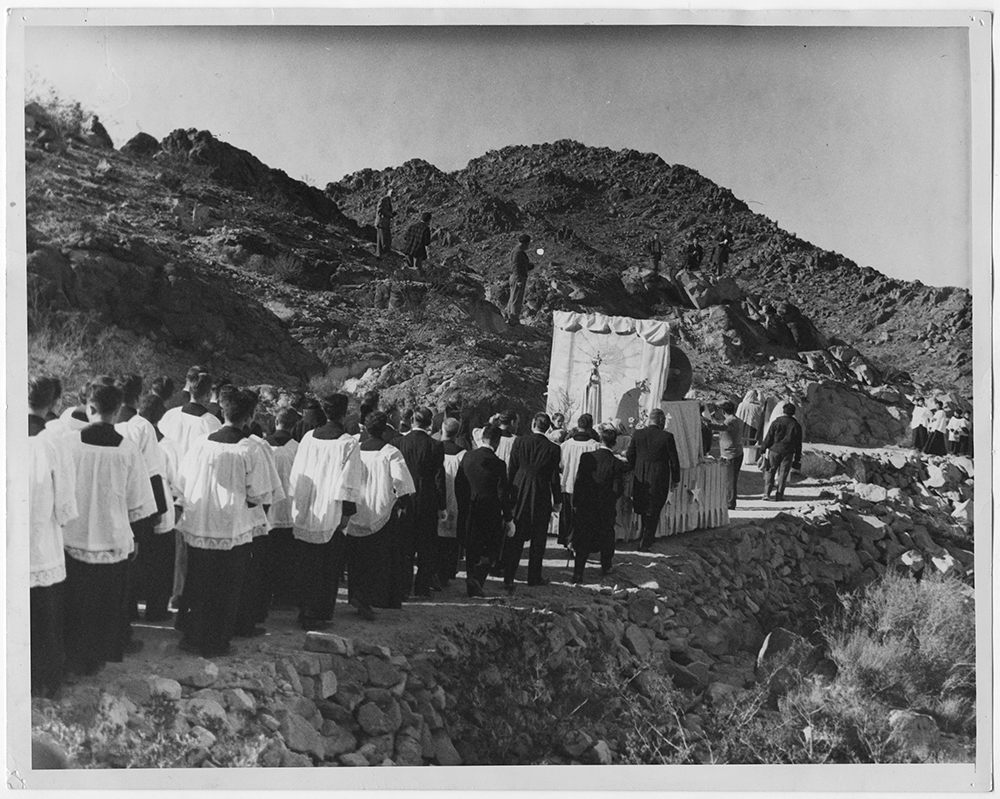
Mount Cristo Rey is the only significant space without a border fence in the El Paso metro area. In 2019, Trump adviser Steve Bannon raised private donations to build a half-mile wall on the eastern side of the mountain on private property. Bannon later pled guilty to defrauding investors.
Last month, construction crews building the border wall in Arizona destroyed a 60- to 70-foot portion of an Indigenous ground etching of a fish thought to be over 1,000 years old. Lorraine Marquez Eiler, a Hia-Ced O’odham elder, told Democracy Now her community questioned whether the construction crews destroyed the intaglio, or etching, on purpose.
And in California last month, Kumeyaay Indigenous people sounded the alarm that the Trump administration was blasting Kuchamaa Mountain, a sacred ceremonial site for their people near the Mexican and Californian towns of Tecate that has been on the National Register of Historic Places since 1992, to prepare for border wall construction.
This article has been updated to add comment from the Diocese of Las Cruces.
Original Source: