(RNS) — Although not known for his piety or his deep knowledge of the Bible or matters of Christian theology, President Donald J. Trump fancies himself presiding over a religious revival, boasting that he has “done more for religion than any other president.”
Last fall, as part of his Freedom 250 commission, he launched the America Prays initiative to encourage Americans to dedicate an hour a week in prayer. As part of this initiative, the commission is staging “Rededicate 250: A National Jubilee of Prayer, Praise, and Thanksgiving,” a gathering on the National Mall in Washington, D.C., on Sunday (May 17), the anniversary of the date the Second Continental Congress recommended observing a “a day of humiliation, fasting, and prayer.”
Prominent members of the Trump administration are slated to attend, including Secretary of State Marco Rubio (via video) and Secretary of Defense Pete Hegseth, as well as Speaker of the House Mike Johnson. A list of speakers consists nearly exclusively of conservative, pro-Trump evangelicals. Two Catholic leaders and one rabbi are scheduled to speak, and so far there is no representation of leaders from mainline Protestant or Black churches or of America’s many other religious traditions. The lineup suggests that behind the inclusive rhetoric of the event’s promotional materials lies a particular vision of American identity — a staging of Christian nationalism.
A question can be raised about a government-sponsored event “solemnly rededicating our country as One Nation under God”: Was the nation ever so dedicated? Throughout our history, there have been American Christians who believed the United States failed at that task. There were Church of England Loyalists who regarded the Patriot endeavor as a rebellion not only against the king but against the divinely instituted political order, and those who were supportive of the revolution but worried the new nation was insufficiently attentive to matters of religion.
Unlike the Declaration of Independence — which appealed to “the Law of Nature and Nature’s God,” spoke of the rights-endowing “Creator” and “Supreme Judge of the world” — or the Articles of Confederation, which spoke of “the Great Governor of the World,” the proposed federal Constitution that came out of Philadelphia in 1787 contained no acknowledgment of the deity whatsoever. Further, Article VI, Section 3 prohibited a religious test for federal office.
Not everyone was pleased. As the states debated ratification, some opponents disparaged the document’s “indifference to religion.” Others warned that the prohibition of a religious test would open the door to public office to infidels like Catholics, Quakers, Jews, deists, “Muhammadans” and pagans. Other anti-Federalists worried that the document did not do enough to protect citizens’ religious liberties and rights of conscience, concerns that were addressed by the religion clauses of the First Amendment.
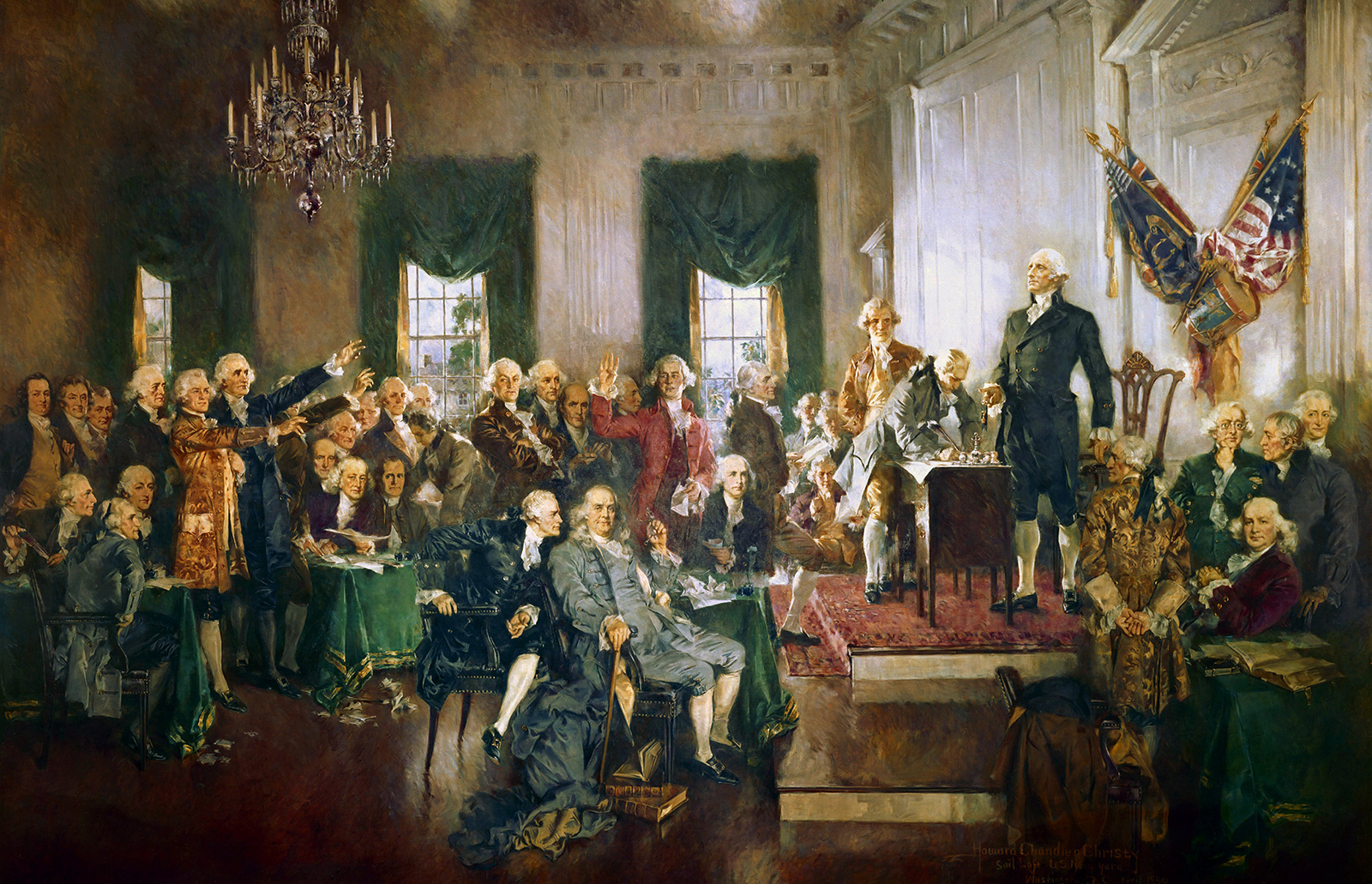
In 1789, a group of Presbyterian ministers wrote to President George Washington to express their disappointment that “some explicit acknowledgement of the only true God and Jesus Christ, whom he hath sent” had not been inserted into the Constitution. The president brushed off their complaint. A year later, he dispatched a more well-known letter to the Hebrew Congregation of Newport, Rhode Island: “The Citizens of the United States of America,” he wrote, “have a right to applaud themselves for having given to mankind examples of an enlarged and liberal policy: a policy worthy of imitation. All possess alike liberty of conscience and immunities of citizenship.”
Nevertheless, there were ministers who continued to press for political attention to be paid to religion. The Rev. John Mitchell Mason, for example, lamented in a 1793 sermon the people’s lack of gratitude to the deity who had delivered them from their adversaries and blessed them with prosperity, and warned of the baleful consequences for the young republic. A few years later, during the heated election season of 1800, he worried that the religiously defective Constitution would make it possible for the “infidel Mr. Jefferson” to be elected president. Jefferson emerged victorious, and most American denominations found themselves able to grow in an environment memorably described by Jefferson as “a wall of separation between Church & State.”
This church-state settlement was widely understood as something new, a departure from past arrangements in Europe and the former British colonies. Most of America’s churches embraced it. In “Democracy in America,” his celebrated study of the young nation’s political institutions and ethos, Alexis de Tocqueville noted how the vibrancy of American Christianity rested on the separation of church and state.
Despite the widespread acceptance of this arrangement, the pressure to formally Christianize the Constitution never disappeared. It surged most powerfully during the Civil War, when both Northern and Southern ministers seized on the national covenant’s godlessness as the root cause of the national catastrophe. The 1861 Confederate Constitution invoked “the favor and guidance of Almighty God” in its preamble. By 1863, a movement in the North had coalesced to dedicate the Union to God.
The National Association to Secure the Religious Amendment of the Constitution of the United States (later the National Reform Association) was spearheaded by the Reformed Presbyterians, descendants of the radical Scottish Protestants who had dissented from the British political settlements of the previous century. Members of the sect practiced “the testimony of political dissent” — refusing to vote, accept any public office or serve on juries until a properly Christian government was established.
For decades, the members of this small denomination prayed for the reformation of the American government but demurred from actively working to alter the Constitution, as doing so would compromise their testimony of political dissent. By the Civil War, however, they had begun to reconsider their mode of engagement and worked with other Protestant denominations to advocate for a constitutional amendment as an act of repentance for national sin. In 1864, a delegation representing the association had an audience with President Abraham Lincoln, who greeted them warmly but did nothing to advance their petition. Nor did Congress take up the proposal.
But the movement persisted. Proponents saw another opportunity in the 1870s, as widespread social changes — mass immigration, an increasingly assertive Catholic population, Mormon polygamy, the growing prestige of Darwinism and “free thought” — disrupted long-standing Protestant dominance over the country. A broad interdenominational Protestant movement promoted a Christian amendment as a matter of national defense. It would serve, its advocates argued, as a legal basis to preserve and defend America’s Protestant culture and heritage — instantiated in such long-standing practices as school prayer and Bible readings, and Sabbath and blasphemy laws — from the forces of “political atheism.” It did not go unnoticed by its opponents that such a measure would have had repressive consequences, effectively annulling the prohibition of a religious test and curtailing the First Amendment’s protection of religious minorities.
The House Judiciary Committee took up the amendment question in 1874 but was not convinced by the association’s argument. Issuing a report that it would be “inexpedient to put anything into the Constitution or frame of government which might be construed to be a reference to any religious creed or doctrine,” the committee requested that it be discharged from any further consideration of the matter.
When Supreme Court Justice David J. Brewer declared America a “Christian nation” in Church of the Holy Trinity v. United States in 1892, the association launched another petition drive to make its case. Then too, the measure died in committee.
The Cold War provided yet another opening. In 1954, the Senate Judiciary Subcommittee on Constitutional Amendments convened to discuss a proposal for a Christian amendment. The only senator in attendance was chairman William Langer of North Dakota. The witnesses who came to testify in support of the measure argued it was all the more urgent in light of the nation’s global leadership in the struggle against communism. The sponsors maintained that the proposed amendment would neither infringe on religious freedom nor discriminate against religious minorities, but this position was not universally held. Also in attendance to support the amendment were a pair of women representing the Christian Patriot Rally, who testified that the amendment would protect the nation from a Jewish plot to undermine Christianity in America’s churches and schools. That effort, like all the earlier attempts, went nowhere.
Such hopes have never completely disappeared, as the latter-day remnants of the National Reform Association, sometimes joined by other voices, continued to advocate for a measure that would bring America to God. In 1989, Gary North, a prominent leader in the Christian Reconstruction movement, published “Political Polytheism,” a massive tome that argued the Constitution was a Masonic conspiracy and proposed rewriting the preamble to make the U.S. an explicitly Christian regime.
More recently, Doug Wilson, an influential Calvinist minister out of Moscow, Idaho, and leader in the Communion of Reformed Evangelical Churches (which counts Hegseth as one of its members), has proposed incorporating the Apostles’ Creed into the document and restricting the holding of national office to professed “orthodox” Christians.
For such men, dedicating the nation to God would require an action more significant and lasting than a prayer rally.
Today, we are a much more diverse nation than we were 250 years ago. Some may look at this with regret and try to obscure this reality with performances of religious dominance, such as those sponsored by Freedom 250 and endorsed by the White House.
The second Trump administration has taken a visibly aggressive posture promoting conservative Christianity. Over the past months, government departments and agencies have hosted prayer meetings for employees and posted Bible verses and theological messages to the public on social media, and the chairman of the Religious Liberty Commission announced that “there is no such thing as ‘separation of church and state’ in the Constitution.”
While it is fitting and proper for individuals and congregations to rededicate themselves to their God in prayer, it is not the role of government to unite America in faith. Instead, in this 250th year of our independence, we should rededicate our nation to the tradition of religious liberty as articulated by James Madison, Thomas Jefferson and George Washington.
(Jerome Copulsky is a research fellow at the Berkley Center for Religion, Peace & World Affairs at Georgetown University and the author of “American Heretics: Religious Adversaries of Liberal Order.” The views expressed in this commentary do not necessarily reflect those of Religion News Service.)
Original Source: