(The Conversation) — I teach writing and rhetoric, but my college students and I often overlook a surprisingly complicated question: What is writing?
And can artificial intelligence really do it?
Many people think of “writing” as putting words on a page. However, even from very early on, writers have seen their craft as something more. From Enheduanna, the first named author on record, to Plato and Aristotle, writing has been portrayed and defined in ways that suggest AI may not be “writing” at all.
If not, what should we call AI text? ChatGPT and I have an idea.
Praising and pleading
Enheduanna, who lived around 2,300 B.C.E., was a powerful princess, priestess and poet of the Akkadian Empire, in what is now Iraq. She has been celebrated as the earliest known writer, though the authorship of her poems and hymns is debated.
One of her poems, “The Exaltation of Inanna,” reveals a sense of what writing is and does – portraying it as a living medium that expresses experience and shapes the future.
First, the poem praises the ancient Mesopotamian goddess Inanna, who was associated with fertility and war, among other powers. “My Lady, you are the guardian / Of all greatness,” Enheduanna says, in a translation by Jane Hirschfield.
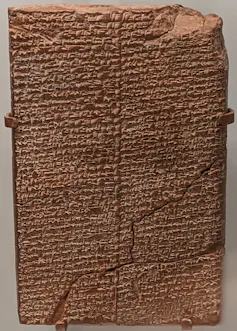
A tablet in the Penn Museum in Philadelphia inscribed with a copy of Enheduanna’s ‘Exaltation of Inanna.’
Masha Stoyanova/Flickr via Wikimedia Commons

That praise may be strategic. It is followed by Enheduanna’s plea to overthrow Lugal-Ane, a rebel king who she describes exiling her and taking her post at the temple of Ur. “Now I have been cast out / To the place of lepers,” she writes, describing her suffering. “Day comes, / And the brightness / Is hidden around me.”
Grieving, Enheduanna writes a new destiny. In a translation by Sophus Helle, the priestess envisions Inanna coming to her aid and “tear[ing] off this fate, Lugale-Ane.” And her pleading seems to be successful: The end of the poem depicts Enheduanna restored to her post.
In Enheduanna’s poetry, writing does not simply communicate information. It interacts with the present and changes the future. The priestess’s pleas please the goddess, move her heart, and she restore Enheduanna to her post – though historians have little evidence of whether an exile and return really happened.
But her poetry did have real-world influence, helping to create religious and political unity in the world’s first empire. For example, her writing merged the Sumerian goddess Inanna with the Akkadian goddess Ishtar, describing a single “Queen of Heaven.”
AI writing can be used to try to create change, such as by swaying someone’s political opinion. But it lacks the human emotions that make experiences like praise, gratitude and suffering possible – the emotions and motivations that make writing a living medium with real-world effects.
Transforming over informing
Two thousand years after Enheduanna, Plato and his student Aristotle offered another influential view of writing – one that complements hers.
In the “Phaedrus,” which discusses the relationship between love and rhetoric, Plato famously defines writing as a poor copy of speech. Speech’s job is to represent thoughts; thoughts, in turn, represent knowledge and truth. Similarly, Aristotle writes, “Spoken words are the symbols of mental experience and written words are the symbols of spoken words.”
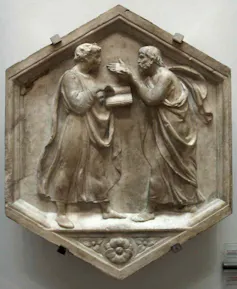
A relief of Plato and his student Aristotle by Italian Renaissance sculptor Luca della Robbia.
sailko/Wikimedia Commons, CC BY-SA

Even that definition marks a sharp contrast with AI, which lacks thoughts and mental experiences. Its output proceeds from data aggregation and text generation.
To understand what writing is, we also need to look at what it does. Although Plato elevates speech over writing, he suggests in “Phaedrus” that good writing may lead a learner toward truth and knowledge. Similar to Enheduanna, he employs writing as a tool for change, both inside and outside the text.
In Plato’s dialogues, characters often radically change their opinions. And today, almost 2,500 years after his death, the philosopher’s real-world impact is clear. For instance, universities and colleges today are collectively called the “Academy” because that was the name of Plato’s group, the first institution of higher learning in the West. English scholar Alfred North Whitehead famously wrote that all Western philosophy is “a series of footnotes to Plato.”
Aristotle’s voluminous works, too, show writing’s purpose transcends communication. In “Rhetoric,” for instance, he details ways to make writing persuasive. Aristotle defines rhetoric as a way of “moving souls,” not just exchanging knowledge.
For both of the Greek philosophers, then, writing is more about transformation than information.
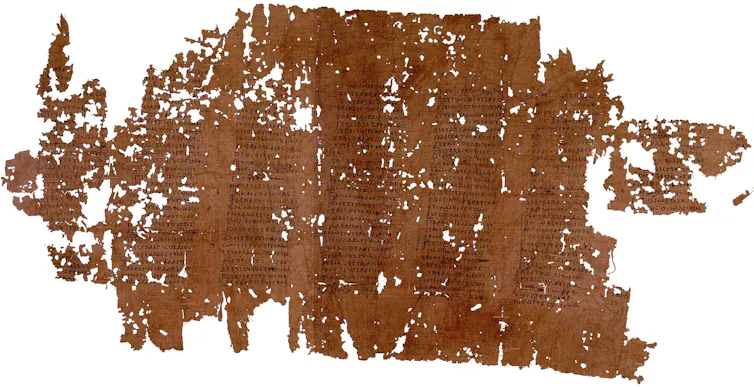
This second-century papyrus of Plato’s ‘Phaedrus,’ found in modern-day Egypt, was reconstructed from several fragments.
Oxyrhynchus Papyri Collection/Oxford’s Art, Archaeology and Ancient World Library via Wikimedia Commons

Today, however, AI tools’ popularity may make writing less dynamic and less moving. Use of AI risks a “blandification” of writing, according to a study led by computer science professor Natasha Jaques. In other words, much AI writing today lacks distinct voices, making it sound the same – which could make people’s thinking more similar, too.
‘Generwriting’
Overall, these three ancient authors agree that writing emerges from thoughts and experiences – a process that strives to create change. Enheduanna, Plato and Aristotle also agree that writing’s essence transcends the simple summaries and information transmission common to AI output today.
Although AI can generate creative texts, its writing may not “move souls” the way human writing does. Several studies show a “pro-human attribution bias” or an “AI penalty,” meaning that people prefer human writing even when AI writing is stylistically similar. People want to read what other people write, not what an algorithm pumps out.
Perhaps we need a different word for AI’s output. Common terms today include “generative content” and “synthetic text,” but I wondered if I could land on something simpler – and involve AI itself. After prompting and tweaking ChatGPT over and over, I settled on one word: “generwrite.”
Though AI is here to stay, new words may help distinguish types of text. And as Enheduanna, Plato and Aristotle remind us, there are elements of writing that may always be unique to embodied, thinking beings striving to move souls.
(Ryan Leack, Assistant Professor of Writing, USC Dornsife College of Letters, Arts and Sciences. The views expressed in this commentary do not necessarily reflect those of Religion News Service.)

Original Source: