(RNS) — Along a well-traveled local road in affluent Malvern, Pennsylvania, a blue and gold historical marker commemorates a nearby mass grave of Irish Catholic immigrants who died in 1832 while building a railroad west of Philadelphia. They died, the marker notes, in the cholera epidemic that struck the city that year, but the marker adds that “Prejudice against Irish Catholics contributed to the denial of care to the workers.”
The story of Duffy’s Cut has been memorialized in books, on television and in song. But last spring, the saga of the estimated 57 men and (a few) women buried at Mile 59 on the Philadelphia and Columbia Railroad took another turn as the mass grave of more than 120 more workers was discovered, in Downingtown, Pennsylvania, on the grounds of a cemetery about 11 miles from Malvern.
Some of the bodies there, excavators soon found, probably did not die of natural causes.
The tragic tale has the resonance of a Netflix thriller — suspicion of long-forgotten crimes, not to mention reports of apparitions haunting the suburban streets that have long since replaced the rural landscape of the 1830s. But local historians say it is less a ghost story than an ugly brew of anti-Catholic and anti-immigrant bias at a time when Irish populations were surging and Catholic institutions were starting to establish themselves in major cities such as Philadelphia.
“It’s really hard for contemporary Americans, (particularly) post-John F. Kennedy Americans, to really fathom the extent of anti-Catholicism in the 19th and early 20th century,” said Julie Byrne, a professor of religion at Hofstra University. Freedom to be self-governing, she added, was a crucial part of American identity, and papal edicts and Catholic monarchies were seen as incompatible with democracy.
When the Irish showed up in America, they were perceived as both racially problematic (sometimes called the “Negroes of Europe”), and “all in for the priests and the popes,” said Byrne.
What happened to the Irish laborers, fresh off the ship the “John Stamp,” was not at first evidently different from more than 900 others who died in the cholera epidemic that hit Philadelphia hard in the summer of 1832, spreading to parts of the surrounding Delaware Valley. But as historians have studied the case, they have come to see that the Irish weren’t given much of a chance.
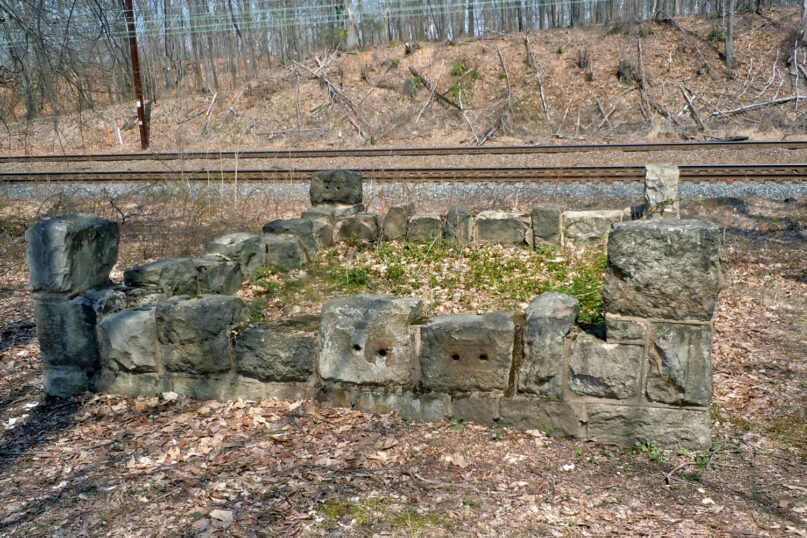
“It’s pretty clear that, however they died, they were not well treated,” said Margaret McGuinness, a religion professor emeritus at La Salle University and author of “Called to Serve: A History of Nuns in America.” The railroad workers, she said, living in tents or shacks near the cut, did not get even the minimal health care they would have received at an almshouse, as they would have in the city of Philadelphia.
The Irish of the early 19th century were seen as many immigrant groups are viewed today, said McGuinness. “They can’t read. They can’t write. They are not Protestant. How can we possibly make them good Americans if they are going to stick with this Catholic Church?”
When cholera struck, the city’s board of health turned to the Sisters of Charity of St. Joseph (now the Daughters of Charity of St. Joseph). The first American women’s religious order, the order had been founded two decades before by Elizabeth Seton, a convert to Catholicism and the daughter of a doctor. One historical account suggests that a few of the sisters from the order’s orphanage in Philadelphia visited the Irish workers’ shanties in August of 1832, when cases of the disease spiked around the region.
A contemporary witness later recorded by historian Julian Sachse recalled the visits, saying, “How these four brave women, clad in the habit of their order, in the hot blazing August sun started cheerfully to walk up the turnpike, carrying large parcels of supplies and medicines, was a sight not to be forgotten even after this long lapse of years.”
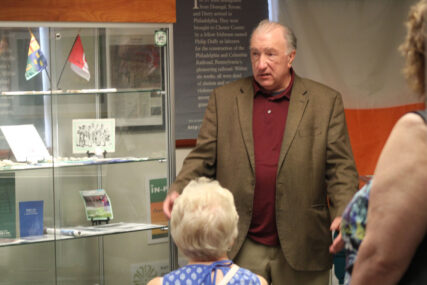
Details about the visit of the Sisters to the Irish shanty beset with cholera don’t go much beyond Sachse’s poetic vision. But the new discoveries lend a chilling dimension to another memory he recorded of them walking back to the city after their visit to the dying. “It is stated that at the sight of their habits doors would be closed and all assistance refused to these persons, who had themselves risked their own lives to save that of their unknown fellowmen.”
Historians have long known that the neighbors around Duffy’s Cut turned the railroad workers away when they appealed to them for help, but it wasn’t until the brothers William and Frank Watson began researching the dead at Duffy’s Cut in the early 2000s that the full story began to emerge.
William Watson, a history professor at nearby Immaculata University, and his brother Frank Watson, a Lutheran pastor and archivist in New Jersey, have been working with a team of volunteers to unearth the bones of those who died at Duffy’s Cut and provide them with resting places in the United States and in Ireland. For the Watson brothers, who have written two books on the topic, the history of Duffy’s Cut is deeply personal: Their late grandfather was an assistant to the president of the Pennsylvania Railroad at the time. They discovered the connection in a file found among his papers.
When their work first began to garner public attention, someone contacted them to suggest there was another mass grave on the grounds of a cemetery in Downingtown, said William Watson. It took the Watsons until around 2020 to be able to begin research on the site where new bone fragments are being found.
Scientists investigating the remains suspect that at least some of the residents of the shanty, likely quarantined to protect the largely Protestant population, met a violent end. “Just examining the skulls, we found what we call perimortem wounds” (wounds suffered about the time of death), “including a compression fracture in which it looked like someone got hit on the head so hard that their skull caved in,” according to team member Matt Patterson, a forensic dentist.
Scott Keefer, provincial archivist for the Daughters of Charity of St. Joseph in Emmitsburg, Maryland, said bias against Catholic immigrants is almost unimaginable today. “You see religious bigotry mixed with anti-immigrant bigotry, and it combines in some strange ways.”
Not all of the Watsons’ chronicles of Duffy’s Cut are strictly history. One night 25 years ago, William Watson and a friend who had stopped by at Immaculata University, happened to look out a window and saw the outline of three glowing figures on the campus lawn (Watson recalls them looking like neon images). Then the figures disappeared, he said.
“It wasn’t just what Tom and I saw,” Watson recalled. “Going back to 1832, it (the area around Duffy’s Cut) was considered an unlucky place. They knew there were a lot of dead people down there.”
When their work became known locally more than a dozen accounts of unexplainable events were submitted to the team, he said.
The story of the travails of the Irish, and the growth of Catholic institutions in the Philadelphia area, doesn’t end with the deaths at Duffy’s Cut. Between the time of cholera and 1850, as Philadelphia Magazine pointed out a decade ago, the Irish population in the city spiked from 35,000 to 170,000. A surge in Catholic parishes followed. McGuinness noted that in Philadelphia at the time, Catholics would not have been allowed to have their doors facing the street.
Frank Watson sees parallels with the way that many American immigrants are treated today. “Our nation has matured in some ways. In others, we have not. It’s a sad thing that we don’t seem to learn from our own history. What the Irish experienced in 1832, a lot of folks are experiencing today.”
Original Source:
https://religionnews.com/2025/11/26/anti-immigrant-bias-may-be-key-to-the-mystery-of-duffys-cut/