(RNS) — Bishop Reginald T. Jackson, a leader of the African Methodist Episcopal Church who was known for his commitment to voting rights and other social justice issues, died on Tuesday (Nov. 25).
Jackson, 71, died in Washington.
“With profound sorrow, the Jackson family announces the passing of Bishop Reginald T. Jackson, who transitioned unexpectedly,” his family said in a Wednesday statement. “We are heartbroken by this immeasurable loss and ask for your prayers, love, and respect for our privacy as we navigate this difficult time.”
Since 2024, Jackson had been serving a second four-year term as the chair of the predominantly Black denomination’s Social Action Commission. Known for his powerful preaching and political connections, Jackson also was the leader of the AME Church’s Second Episcopal District, which includes Maryland, North Carolina, Virginia and the District of Columbia.
“The African Methodist Episcopal Church honors Bishop Jackson’s extraordinary legacy of preaching, teaching, advocacy, and servant leadership,” said Bishop Silvester S. Beaman, president of its Council of Bishops, in a statement. “We extend our prayers and deepest condolences to his family, the Second Episcopal District, and all who mourn his passing.”
RELATED: Black church leader says Target boycott won’t ease until DEI programs return
Political leaders from states where Jackson served over his five decades of ministry responded to his death along with religious officials.
“Mourning the loss of @BishopRTJackson, a leader of the beloved community and a stalwart for justice – wherever it could be made manifest,” former Georgia House Minority Leader Stacey Abrams said in a statement on X. “His tenure in Georgia transformed the lives of millions. He was a good and faithful servant.”
Jackson led the AME district that includes hundreds of churches in Georgia from 2016 to 2024. During that period, he was chair of Atlanta’s Morris Brown College, which regained its accreditation in 2022.
Jackson was among faith leaders who denounced Georgia’s passage of a 2021 elections bill, which banned offering water and food to people waiting in line to vote, and said the measure targeted people of color.
“He was at the forefront of that fight,” Matthew Frankel, an adviser who worked with Jackson on political policy, told Religion News Service. “That was his real passion point, was making sure that everyone who could vote was able to vote.”

Frankel said Jackson had experienced recent health issues but was continuing to serve the church and the bishop’s death was “a shock to the system.”
When he was elected bishop in 2012, Jackson was assigned to the district that included the African countries of Malawi, Tanzania, Uganda and Zimbabwe.
Prior to becoming a bishop, Jackson led congregations in New Jersey, including St. Matthew AME Church in Orange, where he served for 31 years. He also was an educational leader, including president of a public school board and a county college board, and was influential in passage of legislation that ended the state’s death penalty and made racial profiling a crime, according to his biography on the website of the Second Episcopal District.
“Deeply saddened to hear of the passing of Bishop Reginald T. Jackson,” said New Jersey Attorney General Matt Platkin in a statement on X. “He was a legend — a moral compass, a partner in the work of justice, and a voice our entire state relied on.”
Jackson’s connections in New Jersey led to tens of thousands in financial donations from then-Gov. Jon Corzine when he was running as an incumbent for reelection in 2009. Then head of the Black Ministers Council of New Jersey, Jackson confirmed receiving $87,000 in donations, which The Star-Ledger reported after a review of Corzine’s tax return.
Jackson said his endorsement of Corzine was unrelated to the financial gifts.
“I always support who I believe is the best candidate,” said Jackson, who stressed at the time that he had a long relationship with Republican Chris Christie, Corzine’s main rival. The minister said that $37,000 went to the development corporation of St. Matthew AME. The additional $50,000 was a contribution to Jackson’s unsuccessful second run for AME bishop.
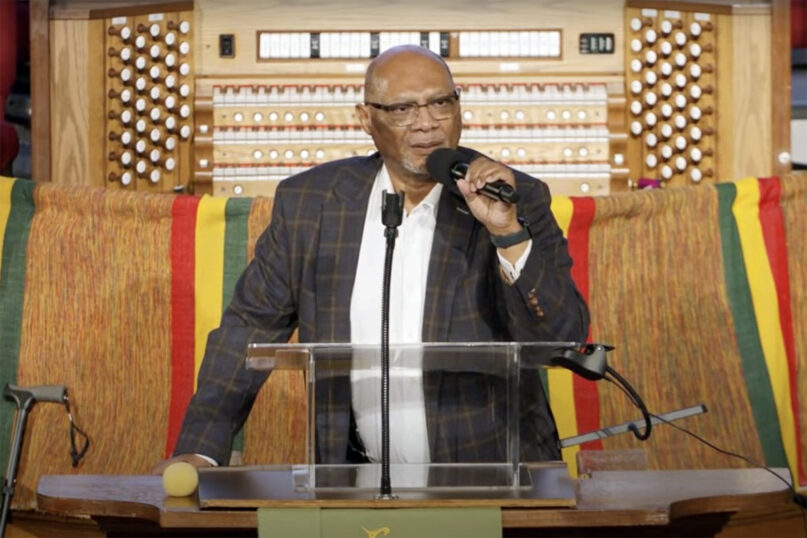
“Just like there are some leaders that people don’t make decisions without consulting with them, that’s who he was in New Jersey,” said Jacquelyn Dupont-Walker, director of the AME Social Action Commission, in an interview.
Jackson eventually became bishop and was “our strongest voice,” as he continued to lead a district with Washington as its base, she said.
“He was an uncompromised conscience,” she told RNS. “Sometimes we say things in ways which are palatable and people will not be offended. He said it from the depth of his soul, and if you were offended, you were just offended.”
Jackson had spearheaded, and the bishops’ council approved, plans for a forthcoming convention including Black churches and other organizations, similar to one held in 1830 by AME Church founder Richard Allen to address social concerns. Dupont-Walker said, with Jackson’s death, the timing of such a gathering is uncertain.
Earlier this year, Jackson had joined in efforts to boycott Target over its scaling back of diversity, equity and inclusion initiatives. He was also vocal in his opposition to Trump administration policies and recent legislation, which Jackson said were having a detrimental effect on African Americans.
“Our churches must rise now,” he wrote in July in The Contrarian, a Substack account described as “Unflinching journalism in defense of democracy.”
“Our people must organize now. We need voter registration drives, policy teach-ins, and loud, public pressure on every member of Congress — Democrats and Republicans alike. We need our young people, our elders, our workers, and our warriors. We need a mass moral movement that makes clear: If you target our survival, we will target your seat.”
Jackson became a widower just short of a year ago when his wife, Episcopal Supervisor Christy Davis Jackson, who led missions activities in the Second Episcopal District, died.
Jackson returned to his native Dover, Delaware, over the weekend, and preached what would be his final sermon at the church where he had once given a sermon as a child, according to Dupont-Walker. Jackson urged the Dover congregants to be faithful beyond the walls of the church building.
“I just want to encourage you to continue to be a church at its best, a church that’s involved in what’s going on in the world,” he said. “The church at its best is not Sunday morning at 10:30. The church at its best is after the benediction, when you leave the Lord’s house, go into the Lord’s world. Make a difference in the Lord’s name, knowing you got God on your side, and he will never leave us alone.”
RELATED: Georgia faith leaders to leave water bottles around Capitol in protest of new voter laws
Original Source: