Religions Around The World

In the early morning hours, monks can be seen walking on their alms round in Kanchanaburi, Thailand
Showing humility and detachment from worldly goods, the monk walks slowly and only stops if he is called. Standing quietly, with his bowl open, the local Buddhists give him rice, or flowers, or an envelope containing money.  In return, the monks bless the local Buddhists and wish them a long and fruitful life.
Christians Celebrate Good Friday
Enacting the crucifixion of Jesus Christ in St. Mary's Church in Secunderabad, India. Only 2.3% of India's population is Christian. 
Ancient interior mosaic in the Church of the Holy Saviour in Chora
The Church of the Holy Saviour in Istanbul, Turkey is a medieval Byzantine Greek Orthodox church.
Dome of the Rock located in the Old City of Jerusalem
The site's great significance for Muslims derives from traditions connecting it to the creation of the world and to the belief that the Prophet Muhammad's Night Journey to heaven started from the rock at the center of the structure.
Holi Festival in Mathura, India
Holi is a Hindu festival that marks the end of winter. Also known as the “festival of colors”,  Holi is primarily observed in South Asia but has spread across the world in celebration of love and the changing of the seasons.
Jewish father and daughter pray at the Wailing Wall in Jerusalem, Israel.
Known in Hebrew as the Western Wall, it is one of the holiest sites in the world. The description, "place of weeping", originated from the Jewish practice of mourning the destruction of the Temple and praying for its rebuilding at the site of the Western Wall.
People praying in Mengjia Longshan Temple in Taipei, Taiwan
The temple is dedicated to both Taoism and Buddhism.
People praying in the Grand Mosque in Ulu Cami
This is the most important mosque in Bursa, Turkey and a landmark of early Ottoman architecture built in 1399.
Savior Transfiguration Cathedral of the Savior Monastery of St. Euthymius
Located in Suzdal, Russia, this is a church rite of sanctification of apples and grapes in honor of the Feast of the Transfiguration of the Lord.
Fushimi Inari Shrine is located in Kyoto, Japan
It is famous for its thousands of vermilion torii gates, which straddle a network of trails behind its main buildings. Fushimi Inari is the most important Shinto shrine dedicated to Inari, the Shinto god of rice.
Ladles at the purification fountain in the Hakone Shrine
Located in Hakone, Japan, this shrine is a Japanese Shinto shrine.  At the purification fountain, ritual washings are performed by individuals when they visit a shrine. This ritual symbolizes the inner purity necessary for a truly human and spiritual life.
Hanging Gardens of Haifa are garden terraces around the Shrine of the Báb on Mount Carmel in Haifa, Israel
They are one of the most visited tourist attractions in Israel. The Shrine of the Báb is where the remains of the Báb, founder of the Bábí Faith and forerunner of Bahá'u'lláh in the Bahá'í Faith, have been buried; it is considered to be the second holiest place on Earth for Bahá'ís.
Pilgrims praying at the Pool of the Nectar of Immortality and Golden Temple
Located in Amritsar, India, the Golden Temple is one of the most revered spiritual sites of Sikhism. It is a place of worship for men and women from all walks of life and all religions to worship God equally. Over 100,000 people visit the shrine daily.
Entrance gateway of Sik Sik Yuen Wong Tai Sin Temple Kowloon
Located in Hong Kong, China, the temple is dedicated to Wong Tai Sin, or the Great Immortal Wong. The Taoist temple is famed for the many prayers answered: "What you request is what you get" via a practice called kau cim.
Christian women worship at a church in Bois Neus, Haiti.
Haiti's population is 94.8 percent Christian, primarily Catholic. This makes them one of the most heavily Christian countries in the world.

Don’t let Christmas take you by surprise: advice on Advent from the Church

null / Lisa Missenda / Shutterstock

Denver, Colorado, Nov 29, 2025 / 12:36 pm (CNA).

The First Sunday of Advent 2025 is tomorrow, Nov. 30, less than four weeks before Christmas this year, and while the Church provides this time to allow you to be caught by the joy of the Incarnation, you can be easily caught by surprise that it is Christmas. To help remedy this surprise, the Church provides songs, signs, and symbols to enter into the season of Advent more fruitfully.

Here are three ways the Church teaches us about the meaning of the season:

Advent hymns

Many of the customary hymns for Advent highlight the movement of the soul toward what Pope Francis termed in a homily on Advent as a “horizon of hope.” No hymn epitomizes this better than “O Come, O Come Emmanuel,” with its overtones of expectation and its mournful remorse over the state of man, captive to sin. The cultivation of hope and expectation is also seen in Advent hymns such as “O Come Divine Messiah” and “People Look East.” 

The commingled darkness and hope that God will fulfill his promises, a theme characteristic of Advent, deepens with songs like the Spanish carol “Alepun.” The lyrics of “Alepun” move the faithful into an experience of waiting with a pregnant Blessed Virgin Mary while the rhythm and percussion evoke donkey hooves clattering across the plains of Israel to Bethlehem.

Church decor

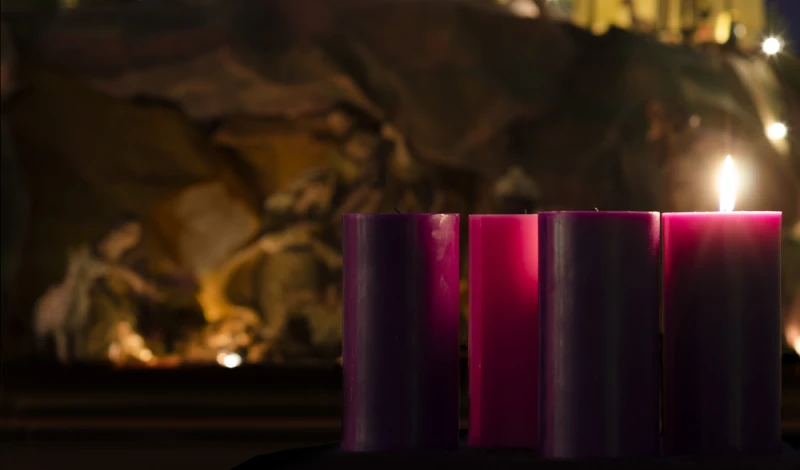
Advent is a season of penance marked by joy and, in many ways, a little Lent. This is why the colors of purple and pink — with their ties to penance and the Lord’s Passion, and the joy of Laetare Sunday when Lent is almost over — are the colors of Advent. But did you know that the deep purple of Advent has a blue hue to it to teach the faithful in symbol about the Marian heart of the season?

The lack of church decor also teaches about the penitential nature of the season. In the weeks leading up to Christmas, the lack of flowers on the altar, the restrained use of instruments, and the absence of the resounding and angelic Gloria all lead to a deliberate emptiness.

The emptiness will first be filled on the solemnity of the Immaculate Conception, and, later, flowers will be allowed on Gaudete Sunday as the first expression of the festivity of the coming Christmas.

Saints and solemnities 

Following the solemnity of Christ the King, Advent begins with echoes of the power of Christ coming in glory before it stretches forward to the humble beginnings of the mystery of the Incarnation.

This means there is a certain focus the Church helps people enter into even in the way the liturgical calendar is marked by very few memorials of saints: just five in the course of the four weeks, most of whom are deeply embedded in the celebration of and preparation for Christmas in various countries.

St. Nicholas is the best known of the five: the generous bishop whose gifts inspired generations of lore and giving. St. Lucy, whose desire to give charity to prisoners in the catacombs meant she wore candles in her hair to free her hands, is another well-known saint with connections to Christmas whom we celebrate in Advent.

The Church also shows forth the importance of Mary during this season, which places her Immaculate Conception on Dec. 8, a solemnity and holy day of obligation, at the very beginning of the liturgical year. Combined with the feast day of Our Lady of Guadalupe on Dec. 12, the Church shows forth what God has wrought in a soul full of grace — a foreshadowing of the entire mystery of salvation in one soul.

Though there are many more signs and symbols that communicate the meaning of Advent, these can assist you as you enter the season of expectation, building anticipation for the celebration of Christmas so it doesn’t catch you by surprise.

This article was first published on Nov. 28, 2022, and has been updated.

Original Source:

https://www.catholicnewsagency.com/news/252923/don-t-let-christmas-take-you-by-surprise-lessons-for-advent-from-the-church