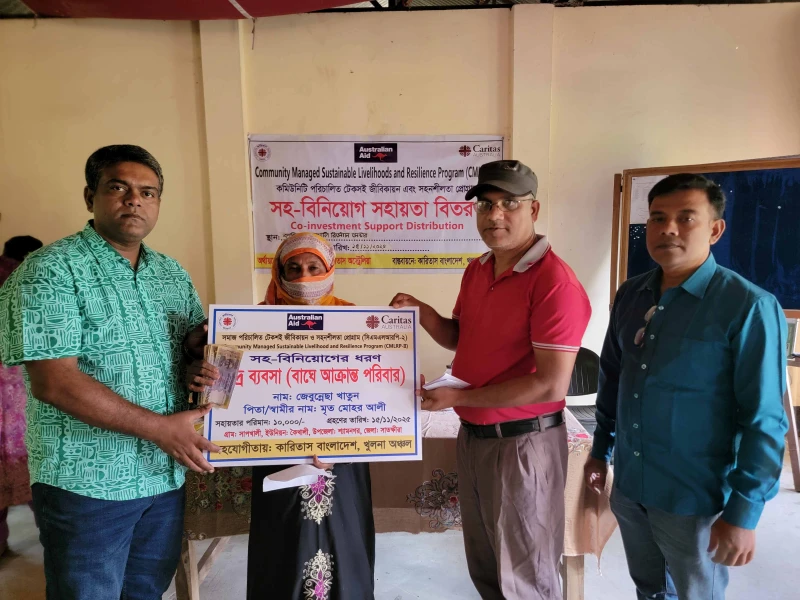
 Tiger widow Zebunnesa Khatun, wife of late Mohor Ali, receives help from Caritas Khulna Region on Nov. 15, 2025. / Credit: Caritas Bangladesh
EWTN News, Nov 29, 2025 / 15:30 pm (CNA).
Rashida Begum still remembers the day her life changed forever: Feb. 2, 2000, when her husband, Mojid Kaguchi, went to catch crabs in the Sundarbans, a vast mangrove forest in southern Bangladesh. Hours later, she heard the news — a tiger had taken him.
"My husband and five others went deep into the forest," Begum told Catholic News Agency. "A roaring tiger attacked one of them. Mojid tried to save his friend, hitting the tiger with a knife. The tiger let go of his friend and grabbed Mojid instead."
The tiger dragged Mojid into the forest. His friends never found him alive.
"After searching, we found only his head and two legs," Begum said. "The tiger ate the rest."
Begum was just 25 then, a mother of two. Married at 20, she had shared only five years with her husband.
Her father-in-law blamed her for his death and refused to give her land. Humiliated, she left her in-laws' home and returned to her father's village.
Life was hard. She worked in fields and homes to feed her children. Today, her sons work in a brick kiln.
"I lost my husband in the Sundarbans," she said. "I will starve if needed, but my sons will never go there."
Begum learned to sew. Recently, Caritas Bangladesh, a social aid agency of the Catholic Church, gave her 10,000 taka (about $81). She bought a sewing machine and fabric.
"I will make clothes and sell them," she said. "I can earn 3,000 taka (about $21) a month."
Amerun Nesa Begum, 48, shares a similar story.
On March 26, 2012, her husband was fishing in the Sundarbans when a tiger attacked.
"There was bleeding from my husband's neck," she recalled. "The tiger was eating him. His friends made noise to scare it away, but my husband died there."
Amerun Nesa, a mother of four, faced extreme poverty. She worked in fields and homes of others. Her sons later went to the Sundarbans to fish, risking their lives.
"The Sundarbans is our main source of income," she said. "We know the risks, but we cannot leave it."
She also received 10,000 taka from Caritas. She bought a sewing machine and fabric. She and her daughter-in-law now make clothes to sell in local markets.
On Nov. 15, Caritas Bangladesh helped 106 poor families, including 12 tiger widows like Rashida and Amerun Nesa. The aid came through the Community Managed Sustainable Livelihood and Resilience Project (CMLRP-II), supported by Caritas Australia.
"Tiger widows" are women whose husbands were killed by Bengal tigers in the Sundarbans mangrove forest while collecting honey, fishing, or cutting wood. These women face severe social stigma, branded as cursed and excluded from community life, alongside economic hardship and psychological trauma.
Santanu Roy, program officer for Caritas Khulna Region, said the widows' lives are heartbreaking.
"They face humiliation and neglect," Roy told Catholic News Agency. "Families slander them. We are happy to help them. This small support can improve their lives."
The Sundarbans spans three districts: Khulna, Satkhira, and Bagerhat. At least 3,000 tiger widows live in villages near the forest.
Roy hopes Caritas can assist more widows.
Apart from tigers, crocodiles also attack men who enter the forest for honey, fish, and crabs.
Tiger widows suffer more than grief. They face stigma. Many are called "husband eaters" or cursed. They are excluded from society.
They also lose their main income source. Most receive no government compensation.
Caritas offers hope. With sewing machines and training, these women can earn a living.
The Catholic Church has long worked in remote areas of Bangladesh. Caritas, its social arm, runs programs for disaster relief, education, and poverty reduction. Helping tiger widows is part of its mission to serve the most vulnerable.
For Rashida Begum and Amerun Nesa, this help means dignity and survival.
"I will never forget my husband," Rashida said. "But now I can dream again."
Amerun Nesa agrees. "I want my children to live without fear," she said. "I pray they never face what I faced."
The Sundarbans is beautiful but dangerous. It is home to the Bengal tiger, a national symbol of Bangladesh. But for poor families, it is also a place of death.
Every year, men enter the forest to collect honey, fish, and crabs. Many go without permits. They risk tiger attacks because they feel they have no other choice.
When tragedy strikes, their families fall into despair. Widows lose income and face social rejection.
Caritas steps in where others do not. Its small grants give women a chance to start again.
The Church's message is clear: every life matters. Every widow deserves hope.
Original Source: