(RNS) — The recently concluded extraordinary consistory, a convening of cardinals to discuss specific topics, gave a mixed message on synodality. At the consistory, they used a synodal process and said many positive things about synodality, but Pope Leo also announced there will be more extraordinary consistories, which is a form of synodality without the laity.
When the cardinals gathered in Rome last year after the death of Pope Francis, many of them had never met. For the first time in history, the cardinals had to wear name tags so they would know each other.
Pope Francis had appointed cardinals from all over the world, including from out-of-the-way places. But in his 12 years as pope, Francis only brought them to Rome for three extraordinary consistories where they could have gotten to know each other. The best-known cardinals were those who worked in the Curia and those who had attended synods.
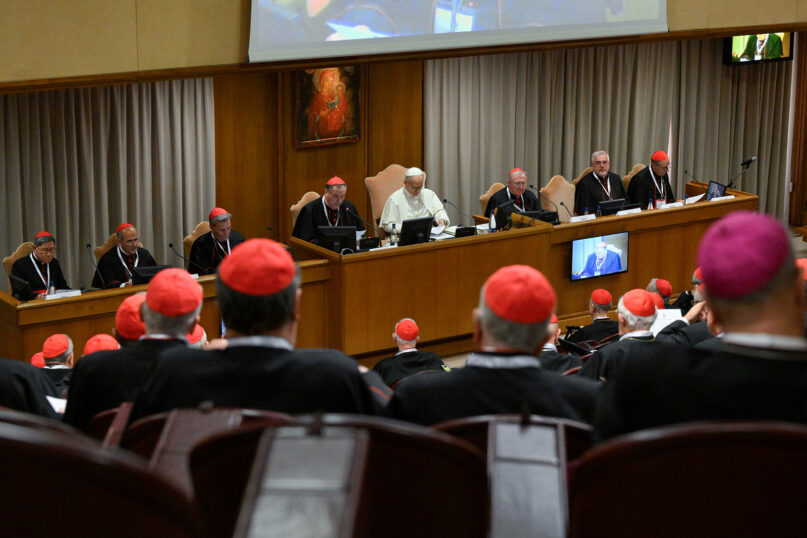
At the conclave, the cardinals expressed their unhappiness with this situation and encouraged the new pope to hold consistories where they could get to know each other and advise him on the governance of the church. Pope Leo heard and responded by calling the cardinals to Rome for an extraordinary consistory (Jan. 7-8).
Under John Paul II there had been six extraordinary consistories. Pope Benedict preferred to meet with the cardinals before ordinary consistories where cardinals were created or people were canonized. Francis hardly ever consulted with the entire college of cardinals, preferring synods or a small group of cardinals who acted as his advisers.
For Leo’s first extraordinary consistory, he suggested four topics as he explained in his opening address: evangelization and the mission of the church in today’s world; the Roman Curia; “the Synod and synodality as both an instrument and a style of cooperation; and the liturgy, the source and summit of the Christian life.”
Before arriving in Rome, he asked the cardinals to reread Pope Francis’ 2013 apostolic exhortation “Evangelii Gaudium” (“The Joy of the Gospel”), which laid out Pope Francis’ vision for evangelization and the mission of the church. To prepare to discuss the Curia, he had them reread Francis’ 2022 constitution on the Roman Curia, “Praedicate Evangelium” (“Preach the Gospel”).
When the 170 cardinals met, however, they voted to focus on only two topics: the mission of the church and synodality, leaving the other topics to a later date. In choosing these two topics, the cardinals embraced two important innovations of the Francis papacy.
The liturgy topic had unhappily become identified in the media with the traditional Latin Mass, which Pope Francis had restricted after Pope Benedict had liberalized its use. While this old Latin Mass is debated fiercely in social media in the United States, it was not a concern for most cardinals.
Curial reform is a perennial topic in the church, and the cardinals concluded it could be postponed.
The focus on the mission of the church indicated that the cardinals agreed with Pope Leo that Pope Francis had laid out the path for the church’s mission in “Evangelii Gaudium.” Mission and evangelization were topics they were all interested in discussing.
The synod and synodality were also topics many felt needed more discussion. About 61 of the cardinals attended the Synod on Synodality, but others did not and they wanted to learn more about synodality. Open questions included how to make synodality more pervasive in the church and the relationship between synodality and the hierarchical church.
Pope Leo’s commitment to the synodal process was clear in his rejection of the old style of extraordinary consistories where curial cardinals made presentations followed by the other cardinals giving speeches. The problem with the old model is that everyone wants to give a speech, but no one wants to listen to them. The process was deadening in its boredom.
A few cardinals, mostly conservative, pushed for this old style because they believed that if they could speak to all the cardinals, they would persuade them to follow their views. The truth is that most cardinals prefer small group discussions rather than scores of boring lectures.
The new consistory process mimicked that of the synod with about 10 or fewer cardinals sitting at 20 round tables organized by language groups. They followed the synodal process of conversations in the Spirit where each cardinal speaks for three minutes while the others respectfully listen before there is open discussion.
The pope described their way of proceeding as “seeking the guidance of the Holy Spirit and walking together” and as “being attentive to the heart, mind and spirit of each; listening to one other; expressing only the main point and in a succinct manner, so that all can speak.”
The consistory did not attempt to produce a document. Rather they felt their journey together was as important as their conclusions. Or put in secular language, the process was more important than the product.
Because time was limited, only tables with cardinals from outside of Rome were allowed to report orally to the full assembly. The others could submit written reports, and as Leo explained, “it is naturally easier for me to seek counsel from those who work in the Curia and live in Rome.” I am sure some of the curial cardinals were not pleased with that.
Since the meeting was behind closed doors, we do not know much about the discussions. Media reports indicated the cardinals were pleased with the process and strongly supported synodality.
The Vatican spokesperson said the cardinals spoke about the importance of lay participation in the leadership of the church, creating ecclesial structures that foster synodality with each member of the church. But the prelates also pointed to the “necessity for guidelines and reference points” for how to enact synodality.
On the other hand, in a leaked speech, Cardinal Joseph Zen Ze-kiun, the bishop emeritus of Hong Kong, condemned the synodal process as an “ironclad manipulation” that was an “insult to the dignity of the bishops.” Which other cardinals felt threatened by synodality is unknown, but some in the hierarchy do see the involvement of the laity as a threat to their authority.
Pope Francis revolutionized synods by including laymen and lay women as voting members. It is no longer a synod of bishops but a synod of the church. This is still controversial with some in the hierarchy. Pope Francis also allowed the synod’s final document to have magisterial authority. While this was always an option under canon law, this is the first time a pope permitted it.
The synodal process used by the consistory and the positive discussion of the topic make it appear that synodality is here to stay in the papacy of Leo, but there is one storm cloud on the horizon.

Pope Leo has indicated he will hold another consistory in late June and plans each year to hold an extraordinary consistory that might go for two to four days. Many, especially the cardinals, applauded this as another indication of Leo’s commitment to synodality, but it is a synodality that excludes the laity. Consistories by their very nature exclude the laity unless the pope plans to appoint lay cardinals.
It remains to be seen how often Pope Leo will make use of the synod. My fear is that the college of cardinals will become the preferred body for papal consultation and synods will be less frequent and less important. I hope I am wrong, but synods are more complicated and difficult to pull off. Consistories involve fewer people and take less time; even so, it is time that will not be available to plan and execute more complicated synods. With more consistories, the temptation will be to have fewer synods.
Leo could have taken another route. He could have called for an annual extraordinary synod, which is made up of curial officials, presidents of episcopal conferences and appointed bishops. He could have added lay members to such a synod just as Francis added lay members to the ordinary synod. He could have excluded curial officials to keep the size down, since after all, as he said, he can always consult with them.
John Paul II loved both synods and consistories, although discussion was carefully controlled. He had 15 synods and six extraordinary consistories, which made me wonder if the church was going to have a bicameral system equivalent to the House of Lords (college of cardinals) and the House of Commons (synod).
Francis preferred broader consultation through the synod with laity added. Until we see what Leo’s plans are for the synod, we will not know whether he prefers synodality with or without the laity. Never underestimate the ability of clericalism to triumph in the Catholic Church.
But Leo does not seem interested in returning to the past. He hopes for a creative church full of life.
“Is there life in our Church?” he asked the cardinals. “Is there space for something new to be born? Do we love and proclaim a God who sets us on a journey?”
He does not want the cardinals to close themselves off and say, “Everything is already done, finished, do as we have always done.” Rather, he believes “(t)here really is a path, and with the work of these days, we are walking together.”
“Let us stay together,” he concludes. “There may be things that frighten us; there may be doubts: Where are we going? How will it all end? But if we place our trust in the Lord, in his presence, we can do so much.”
Original Source:
https://religionnews.com/2026/01/12/does-pope-leo-want-synodality-without-the-laity/